
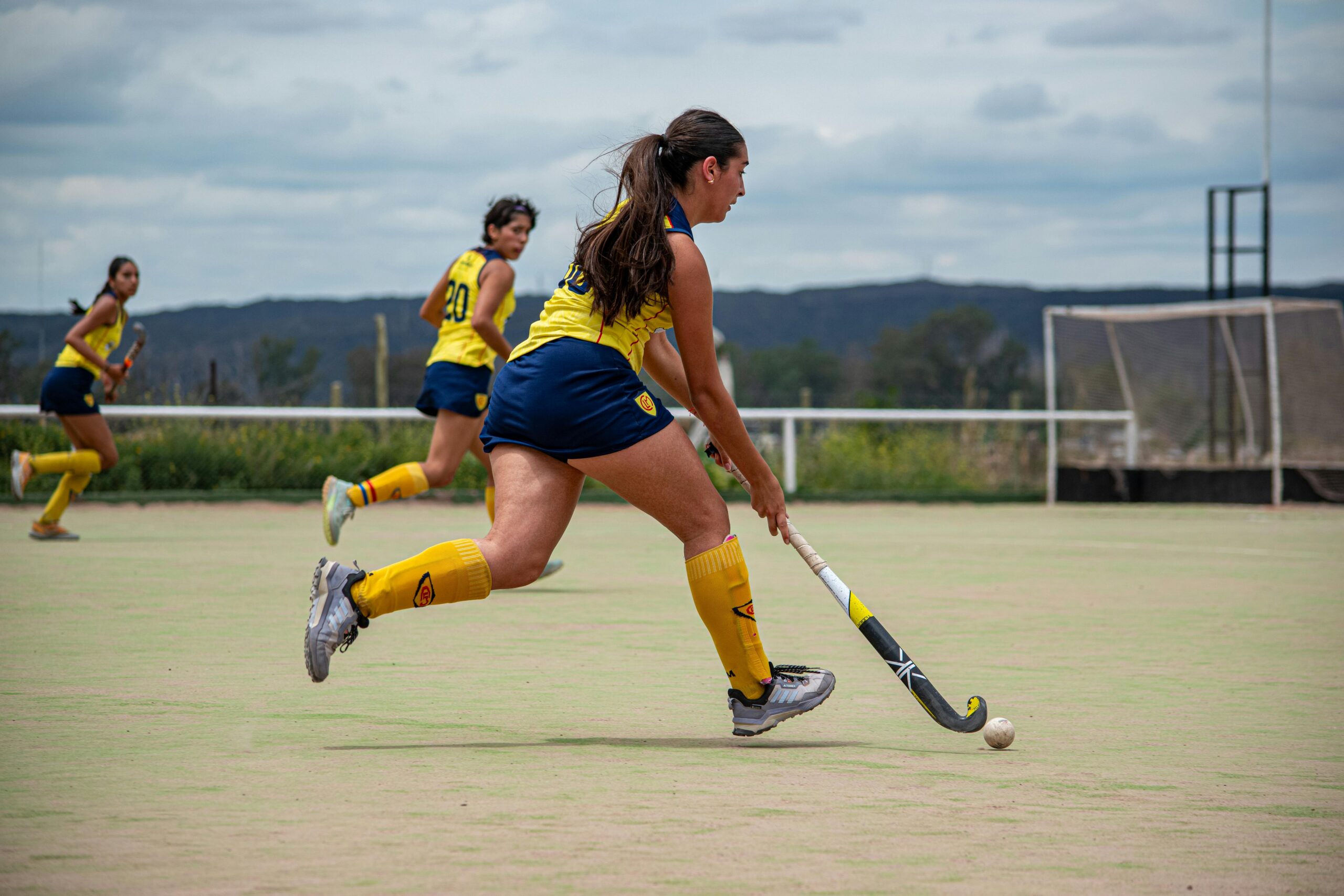
In field hockey, having open space in front of you is a gift, but it means absolutely nothing if you cannot exploit it.
At Athletes Untapped, we notice that many young players struggle to maintain their natural running speed while carrying the ball. They chop their steps, keep the ball tangled under their feet, and constantly look down at the turf. This lack of structural mechanics leads to losing breakaways, allowing recovering defenders to catch up, and highly inconsistent transition offense.
The secret to a lethal counter-attack lies in ball carrying speed. Proper training fixes these posture and stick-handling issues, allowing players to transfer their track speed onto the turf, pushing the ball smoothly into space while keeping their eyes up to scan the field.
Connect with a Private Field Hockey Coach: https://athletesuntapped.com/browse/field-hockey/
Why This Skill Matters for Athlete Development
Your ability to carry the ball at maximum velocity dictates how dangerous you are in transition. Without a consistent, efficient carrying technique, your team’s counter-attack will always stall.
- Game Performance: Elite ball carrying speed directly translates to creating numerical advantages. When you can sprint with the ball faster than a defender can backpedal, you force the defense to collapse on you. This opens up massive passing lanes for your teammates and makes it significantly harder for the opposition to set up their defensive structure.
- Confidence: I have seen athletes improve faster when they spend just 10 focused minutes on this drill at the start of every session. When carrying the ball at top speed becomes muscle memory, players stop panicking on breakaways. They gain the composure to trust their stick skills, keep their head on a swivel, and execute a confident, aggressive drive into the attacking circle.
- Long-Term Development: As you progress to higher levels of field hockey, the game moves almost exclusively to fast, water-based artificial turfs. A biomechanically sound carrying posture protects you from tripping and losing possession on these lightning-fast surfaces. It provides the technical foundation needed to attack space instantly, ensuring your transition game scales as you face elite, high-speed competition.
Best Drills / Tips / Techniques
You cannot master ball carrying speed by simply jogging through cones. You need isolated, high-repetition sprint drills to build confidence pushing the ball into space. Here are 5 drills AU coaches use to build breakaway speed.
1. The Open Space Push
- How to perform it: Stand on the baseline. Push the ball five to eight yards diagonally out in front of your right foot (the 2 o’clock position). Sprint after it, catch up to it, and give it another long, smooth push without breaking your stride. Continue this pattern all the way to the opposite baseline.
- Why it works: It forces the brain to internalize the concept of separating from the ball. It breaks the carry down to its simplest component of pushing and sprinting, rather than constantly tapping the ball with every single step.
- Coaching tips: Let your legs do the running. Your stick should only contact the ball to guide it, not to baby-sit it.
- Common mistakes: Tapping the ball continuously. If you tap the ball with every step, you are physically unable to reach your maximum sprinting stride.
2. The One-Handed Acceleration
- How to perform it: Start at the 50-yard line. Begin carrying the ball using the standard two-handed grip. After ten yards, take your right hand completely off the stick, drop your hips slightly, and sprint for twenty yards using only your left hand to guide the ball out in front of you.
- Why it works: Running with two hands on the stick locks your shoulders and restricts your natural sprinting mechanics. This drill isolates the one-handed open stick carry, allowing your right arm to pump naturally to generate absolute maximum velocity.
- Coaching tips: Your left wrist must remain incredibly strong. Rotate the toe of the stick slightly over the ball to keep it from bouncing away.
- Common mistakes: Letting the ball drift too far across the body to the left side, which exposes it to a defender’s tackle and forces an awkward running posture.
3. The Vision Grid Sprint
- How to perform it: Set up a 30-yard sprinting channel. Have a coach or partner stand at the end of the channel holding up different colored cones or fingers. Sprint down the channel with the ball at full speed, shouting out the colors or numbers the coach is displaying as you run.
- Why it works: In a real game, running fast with your head down usually results in crashing directly into a defender. This drill marries top speed carrying with visual awareness, teaching the nervous system how to scan the field while maintaining stick control.
- Coaching tips: Rely entirely on your peripheral vision to track the ball. Trust that the ball is exactly where you pushed it.
- Common mistakes: Looking up, shouting the number, and then immediately dropping the chin back to the chest. The head must remain up for the entire sprint.
4. The Slalom Speed Weave
- How to perform it: Set up five tall cones in a straight line, spaced seven to ten yards apart. Sprint with the ball, maneuvering through the cones using wide, sweeping pulls rather than tight, choppy Indian dribbles.
- Why it works: Field hockey is rarely played in a perfectly straight line. This drill teaches the athlete how to change directions at high speeds without decelerating, utilizing the open space push on angles.
- Coaching tips: Drop your outside shoulder as you make your cut around the cone to maintain your balance and centrifugal force.
- Common mistakes: Slowing down dramatically before every cone. You must attack the space next to the cone, not the cone itself.
5. The Chase-Down Simulation
- How to perform it: The ball carrier starts on the 25-yard line facing the goal. A defender starts three yards behind them. On the whistle, the ball carrier must sprint toward the shooting circle and get a shot off before the trailing defender can catch them and make a tackle.
- Why it works: Pressure changes everything. This drill forces the athlete to apply their ball carrying mechanics under extreme, game-realistic stress, simulating exactly what a breakaway feels like in a championship match.
- Coaching tips: Do not look over your shoulder. Looking back slows you down instantly. Trust your speed and focus entirely on the goal ahead.
- Common mistakes: Panicking and dragging the ball back into the body to protect it, which inherently kills all forward momentum and allows the defender to make the tackle.
Find a Private Field Hockey Coach: https://athletesuntapped.com/browse/field-hockey/
Common Mistakes Athletes Make
Ball carrying errors are incredibly common in youth and high school field hockey, but they are easy to fix once identified on the turf.
- Keeping the Ball Too Close: This happens when a player carries the ball directly between their feet or right at their toes. This acts as an immediate trip hazard and physically prevents the knees from driving forward into a full sprint.
- How to fix it: Implement a strict 2 o’clock rule. The ball must live a full stick-length away from your body, out in front of your right foot, allowing you to run freely.
- The Upright Jog: Players often stand straight up when they get the ball, running tall and stiff. This raises the center of gravity, makes the stick angle too steep, and destroys all explosive acceleration.
- How to fix it: Constantly remind yourself to drop your hips and bend your knees. You must play low to the ground to achieve an optimal, flat stick angle against the turf.
- Death Gripping the Stick: Holding the stick so tightly with both hands that the shoulders tense up and the arms become rigid, making smooth adjustments impossible.
- How to fix it: Loosen your right hand entirely. Your right hand should act as a loose guide ring, while your left hand does the turning and steering.
- Over-Dribbling in Open Space: Choosing to aggressively Indian dribble side-to-side when there is thirty yards of wide-open green turf ahead. This wastes energy and allows the defense to reorganize.
- How to fix it: Learn to identify space. If no one is within five yards of you, push the ball long and run. Save the tight dribbling for when you are actually engaging a defender.
How Private Coaching Accelerates Improvement
Ball carrying speed happens in a fraction of a second. Trying to self-diagnose whether your left wrist was rotated properly or your ball position was too central is incredibly difficult while you are sprinting down the field.
This is where private coaching is essential. Private coaching provides faster skill development by utilizing expert eyes and real-time stride analysis. A private coach offers personalized feedback tailored to your specific running mechanics, making it easy to catch habits like the upright jog immediately. This targeted instruction allows athletes to focus on correcting mistakes early before they become ingrained muscle memory. Ultimately, mastering your carrying speed in a 1-on-1 environment provides massive confidence building, allowing you to step onto the pitch knowing you have the tools to outrun anyone on the opposing team.
Frequently Asked Questions About Ball Carrying Speed in Field Hockey
How often should athletes practice this skill?
Athletes should practice their open space pushes and one-handed carries for at least 10 to 15 minutes during their warm-up before every session. Daily repetition is required to make the extended ball position feel natural.
What age should athletes start working on this?
Players as young as 8 or 9 can begin learning the basic concepts of pushing the ball forward and running. The earlier the mechanics of separation are introduced, the less un-teaching has to happen later.
How long does it take to improve?
With focused, intentional practice, players can see a dramatic improvement in their breakaway speed in just 3 to 4 weeks. Breaking the habit of continuously tapping the ball may take slightly longer.
Can beginners learn this?
Yes. In fact, it is often easier for true beginners to learn because they do not have the deeply ingrained habit of staring directly down at their feet while running.
Should I use one hand or two hands to carry the ball fast?
For absolute maximum speed over long, open distances, a one-handed carry (left hand on the top of the stick) is always the fastest method because it allows natural arm pumping. Two hands should be used when approaching a defender.
Do private coaches help with this?
Absolutely. Private coaches are essential for breaking down the biomechanics of the sprint, providing pressure simulations, and isolating specific posture flaws so the athlete can practice effectively.
Conclusion
Ball carrying speed is the undeniable foundation of a dangerous, transition-oriented field hockey player. Without it, you are leaving your offensive advantages on the table and playing directly into the recovering defense’s hands. Improvement is highly achievable with proper training, but it requires discipline. Encourage yourself to focus on your ball placement and your low posture before you focus on shooting, and consistent practice will inevitably yield explosive breakaways and more scoring opportunities.
Train With a Private Field Hockey Coach
Athletes Untapped connects athletes with vetted private coaches across the country for one-on-one training.
Private coaching helps athletes:
- improve faster
- build confidence
- receive personalized feedback
- reach their full potential
About Athletes Untapped
Athletes Untapped connects field hockey players with experienced private coaches who specialize in ball carrying speed, stickwork mechanics, and transition offense. Through personalized instruction and structured training plans, Athletes Untapped helps forwards and midfielders improve open-field acceleration, vision, and breakaway execution.
Find an experienced coach near you: https://athletesuntapped.com
Learn from our very best Coach!


