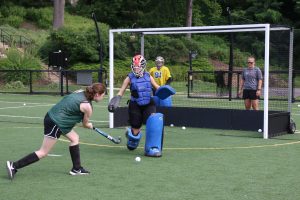

In sports, physical talent sets your baseline, but your emotional state dictates whether you can actually access that talent when it matters most. You can have the best mechanics in the world, but if your nervous system is spiraling out of control, your body simply will not execute.
At Athletes Untapped, we notice that many highly skilled athletes struggle when adversity strikes. They let a bad call by a referee, a missed shot, or an opponent’s trash talk hijack their brain. This lack of cognitive structure leads to spiked heart rates, severe muscle tension, poor decision-making, and highly inconsistent game day production.
The secret to performing under immense pressure lies in emotional regulation. Proper mental training fixes these psychological spirals, allowing athletes to recognize rising tension, reset their nervous system, and channel their energy into cold, calculated execution.
Connect with a Mental Performance Coach: https://athletesuntapped.com/browse/mental-performance/
Why This Skill Matters for Athlete Development
Your emotional state is the filter through which all your physical skills must pass. Without a consistent, regulated nervous system, your mechanics and your game IQ will always break down under stress.
- Game Performance: Elite emotional regulation directly translates to clutch execution. When you can stay in your optimal zone of arousal, you maintain peripheral vision, fine motor skills, and logical decision-making. This keeps you entirely in the present moment, slows the game down, and makes it significantly harder for the opposition to rattle you.
- Confidence: I have seen athletes improve faster when they spend just 10 focused minutes on this drill at the start of every session. When resetting your nervous system becomes muscle memory, players stop fearing mistakes. They gain the composure to trust their breath, let go of the past, and execute a confident, aggressive play when their team needs it most.
- Long-Term Development: As you progress to higher levels of competition, the external pressure and distractions increase exponentially. A biomechanically sound physical routine is useless if your mind is overwhelmed by anxiety or rage. Mental performance training protects you from burnout and performance anxiety. It provides the psychological leverage needed to thrive in hostile environments, ensuring your mental toughness scales as you face elite competition.
Best Drills / Tips / Techniques
You cannot master your emotions by simply telling yourself to “calm down.” You need isolated, high-repetition mental drills to build cognitive endurance and nervous system control. Here are 5 drills AU coaches use to build an unbreakable mind.
1. Box Breathing (Tactical Breathing)
How to perform it: Inhale deeply through your nose for 4 seconds, hold that breath in for 4 seconds, exhale slowly through your mouth for 4 seconds, and hold your lungs empty for 4 seconds. Repeat this box cycle four to five times.
Why it works: It forces the brain to internalize the feeling of a lowered heart rate. It breaks emotional flooding down to its absolute simplest component of oxygen regulation, physically shifting the body from the “fight or flight” sympathetic nervous system back to the “rest and digest” parasympathetic state.
Coaching tips: Breathe deep into your diaphragm (your stomach should expand), not shallowly into your chest.
Common mistakes: Rushing the counting because you are anxious. You must maintain a slow, steady, and honest 4-second rhythm.
2. The Physiological Sigh
How to perform it: Take one deep, sharp inhale through the nose. Immediately take a second, shorter inhale through the nose to fully expand the lungs. Then, release a long, slow, extended exhale through the mouth.
Why it works: This specific breathing pattern rapidly offloads carbon dioxide from the bloodstream and reinflates collapsed alveoli in the lungs. It is the fastest, scientifically proven way to reduce acute physiological stress in real-time.
Coaching tips: Use this immediately after a high-stress moment on the field, like committing a foul or making a critical error, before the next play begins.
Common mistakes: Making the exhale too short. The calming effect comes entirely from the extended, slow exhale.
3. Name It to Tame It (Emotional Labeling)
How to perform it: When you feel yourself losing control, pause for a split second and internally label the exact emotion you are feeling. Say to yourself, “I am feeling frustrated right now,” or “I am feeling anxious about this free throw.”
Why it works: Acknowledging the emotion moves the brain’s activity away from the emotional center (the amygdala) and into the logical problem-solving center (the prefrontal cortex). It creates a layer of separation between you and the emotion, preventing it from consuming your actions.
Coaching tips: State the emotion objectively as a passing state, not an identity. Say “I am feeling anxious,” rather than “I am an anxious person.”
Common mistakes: Judging yourself for having the emotion. Emotions are natural biological responses; the goal is to recognize them without judgment so you can move past them.
4. The Mental Flush (Physical Trigger)
How to perform it: Choose a physical action that you can perform anywhere on the field or court, such as wiping the bottom of your shoes, unstrapping and restrapping your batting gloves, or picking up a blade of grass and tossing it. Pair this physical action with the mental decision to “flush” the previous mistake out of your mind.
Why it works: Emotions drag your focus into the past. Executing a physical trigger acts as a tangible anchor to reality. It snaps your attention back into the present moment, signaling to the brain that the mistake is over and cannot be changed.
Coaching tips: You must execute this routine every single time you make a mistake, no matter how small, to build the neurological habit.
Common mistakes: Performing the physical trigger but continuing to mentally dwell on the error. The physical action must be paired with genuine mental release.
5. Reframing the Narrative
How to perform it: When your internal voice starts feeding you negative, panic-inducing thoughts (e.g., “I’m going to blow this game”), intentionally intercept that thought and reframe it into an action-oriented, productive statement (e.g., “This is a high-pressure situation, and I am going to focus entirely on my follow-through”).
Why it works: Stress and excitement are practically identical physiological responses (spiked heart rate, adrenaline). Reframing teaches the athlete to interpret those physical sensations as their body preparing to do something great, rather than as a sign of impending failure.
Coaching tips: Do not try to feed yourself toxic positivity or lie to yourself. Reframe the narrative to focus on the process and the mechanics, which are entirely within your control.
Common mistakes: Letting the negative thought spiral for several minutes before trying to reframe it. You must catch and replace the thought the absolute second it enters your mind.
Common Mistakes Athletes Make
Emotional errors are incredibly common in amateur and professional sports alike, but they are easy to fix once you build awareness of your own thought patterns.
Suppressing the Emotion: This happens when a player feels intense anger or fear and tries to shove it down and pretend it does not exist. Suppressed emotions act like a shaken soda bottle; they build pressure until they explode in the form of a massive physical error or a meltdown.
How to fix it: Implement the “Name It to Tame It” drill. Acknowledge the feeling for exactly what it is, process it for three seconds, and then let it go.
Riding the Emotional Rollercoaster: Getting too hyped and arrogant after a great play, and getting utterly devastated after a bad one. This violent swinging of emotions exhausts the central nervous system and leaves you drained by the end of the game.
How to fix it: Constantly remind yourself to stay neutral. Strive to maintain a flat, even-keeled emotional baseline regardless of whether you just scored a game-winner or turned the ball over.
Focusing on the Uncontrollables: Wasting emotional energy getting furious at the referee’s calls, the weather, the playing surface, or the opposing fans. You have zero control over these things, and focusing on them only breeds helpless frustration.
How to fix it: Drill your circle of control. Focus 100 percent of your mental energy solely on your attitude, your effort, and your immediate physical execution.
The “Don’t” Syndrome: Telling yourself “Don’t strike out,” “Don’t miss this putt,” or “Don’t drop the ball.” The human brain struggles to process negative commands and instead visualizes the exact mistake you are trying to avoid.
How to fix it: Only give yourself positive, action-oriented commands. Replace “Don’t miss” with “Smooth release” or “Keep your eye on the ball.”
Find a Mental Performance Coach: https://athletesuntapped.com/browse/mental-performance/
How Private Coaching Accelerates Improvement
Emotional regulation happens entirely inside your own head in a fraction of a second. Trying to self-diagnose whether your breathing was too shallow or your self-talk was turning negative is incredibly difficult while you are in the heat of a competitive battle.
This is where private coaching is essential. Private coaching provides faster skill development by utilizing expert observation and targeted psychological questioning. A private mental performance coach offers personalized feedback tailored to your specific emotional triggers, making it easy to catch habits like negative body language immediately. This targeted instruction allows athletes to focus on correcting thought patterns early before they become ingrained mental roadblocks. Ultimately, mastering your emotional regulation in a 1-on-1 environment provides massive confidence building, allowing you to step into the arena knowing you have the psychological tools to handle any adversity.
Frequently Asked Questions about Emotional Regulation in Sports
How often should athletes practice this skill?
Athletes should practice their breathing and reframing drills for at least 10 to 15 minutes a day, away from their sport. Daily repetition is required to literally rewire the brain’s neural pathways for emotional control under stress.
What age should athletes start working on this?
Players as young as 8 or 9 can begin learning the basic concepts of deep breathing and letting go of mistakes. The earlier these mental mechanics are introduced, the less psychological un-teaching has to happen later.
How long does it take to improve?
With focused, intentional practice, athletes can see a dramatic improvement in their composure and emotional control in just 3 to 4 weeks. Breaking the habit of intense negative self-talk spirals may take slightly longer.
Can beginners learn this?
Yes. In fact, it is often easier for true beginners to learn because they do not have the deeply ingrained habit of linking their entire identity and self-worth to their athletic performance.
Is it bad to be angry or hyped up during a game?
Not necessarily. Anger and hype can provide short-term adrenaline, but they burn immense amounts of energy and destroy fine motor skills. The goal is not to be emotionless, but to ensure that you are controlling the emotion, rather than the emotion controlling you.
Do private coaches help with this?
Absolutely. Private mental performance coaches are essential for breaking down the psychology of the game, providing stress inoculation drills, and isolating specific cognitive flaws so the athlete can practice effectively.
Conclusion
Emotional regulation is the undeniable foundation of a clutch, dominant athlete. Without it, you are leaving your performance to chance and playing directly into the opponent’s hands by allowing external chaos to dictate your internal state. Improvement is highly achievable with proper mental training, but it requires discipline. Encourage yourself to focus on your breathing, your physical triggers, and your present moment before you focus on the final score, and consistent practice will inevitably yield a quiet mind and explosive physical results.
Train With a Private Mental Performance Coach
- Athletes Untapped connects athletes with vetted private coaches across the country for one-on-one training.
- Private coaching helps athletes:
- improve faster
- build confidence
- receive personalized feedback
- reach their full potential
About Athletes Untapped
Athletes Untapped connects athletes with experienced private coaches who specialize in emotional regulation, sport psychology, and mental resilience. Through personalized instruction and structured mental training plans, Athletes Untapped helps athletes across all sports improve emotional control, overcome performance anxiety, and execute flawlessly under pressure.
Find an experienced coach near you: https://athletesuntapped.com
Learn from our very best Coach!