
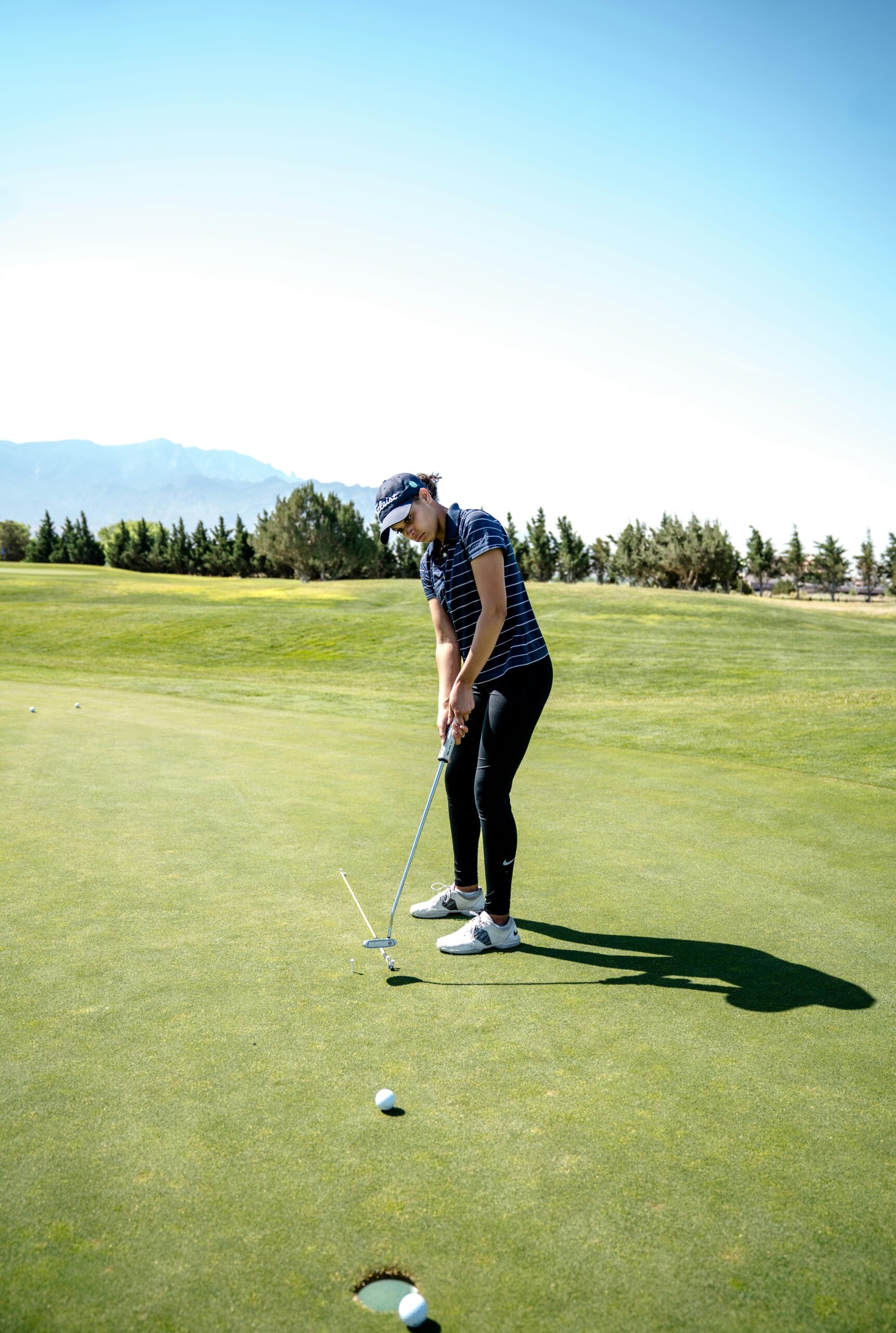
In golf, everyone wants to talk about how far they can hit their driver, but the game is truly won by knowing exactly how far you hit every other club in your bag. You can have the smoothest swing in your foursome, but if you have a 20-yard gap between your 7-iron and 8-iron, or if your three wedges all fly the exact same distance, you will find yourself constantly guessing on the golf course.
At Athletes Untapped, AU coaches notice that many amateur golfers suffer from compressed gapping. They carry 14 clubs, but because of inconsistent strike locations or poor equipment loft calibration, four of those clubs might fly within five yards of each other. This lack of structural clarity leads to awkward half-swings, between-club indecision, and a highly frustrating inability to stick approach shots close to the pin.
The secret to lower scores and elite course management lies in proper golf distance gapping. Proper training and data analysis fix these overlapping ranges, allowing players to establish a predictable, linear progression of carry distances from their lob wedge all the way up to their driver.
Connect with a Private Golf Coach: https://athletesuntapped.com/browse/golf/
Why Golf Distance Gapping Matters for Athlete Development
Your distance gapping is the roadmap for your strategy. Without a clear understanding of your yardages, you are essentially playing with a broken GPS.
- Game Performance: Elite gapping directly translates to proximity to the hole. When you know that a smooth 9-iron carries exactly 135 yards, you stop trying to kill a pitching wedge or finesse an 8-iron. This mathematical certainty reduces mental fatigue and ensures that even your slightly off-center hits still land safely on the green.
- Confidence: Our coaches have seen athletes improve faster when they spend dedicated time on a launch monitor at the start of every season to map their bag. When you see the data prove your yardages, you stop second-guessing yourself over the ball. You gain the composure to commit to a swing, trusting that the club in your hands is the absolute correct tool for the job.
- Long-Term Development: As your clubhead speed increases and your ball-striking improves, your gaps will naturally shift. A biomechanically and tactically sound understanding of gapping allows you to adjust your set makeup, perhaps swapping a long iron for a hybrid or adding a fourth wedge. This ensures your equipment scales with your skill level, keeping your game optimized for any course condition.
Best Drills and Techniques for Dialing in Distances
You cannot master distance gapping by simply hitting a bucket of balls into an open field and guessing where they land. You need data-driven sessions and specific carry-distance targets. Here are 5 techniques AU coaches use with their athletes to build a predictable, precise golf bag.
1. The Bag Mapping Session
The Setup: Use a high-quality launch monitor at an indoor facility or a driving range equipped with tracking technology.
The Action: Hit 5 to 10 good shots with every single club in your bag, starting from your highest lofted wedge up to your driver. Ignore the total distance, which depends on roll, and write down strictly the carry distance. Calculate the average for each club, throwing out the extreme mishits.
Why It Works: Most golfers guess their distances based on their absolute best shot once every three rounds. This drill provides the real-world average. It highlights where your gaps are too large, such as more than 15 yards, or too small, giving you a clear objective for practice or equipment adjustment.
Coaching Cue: Swing at your normal, stock speed. Do not swing out of your shoes just because a machine is tracking you.
Common Mistakes: Counting a heavily thinned or chunked shot in your averages, which artificially lowers your true carry number.
2. The 10-Yard Ladder Drill
The Setup: On the practice range, identify physical targets or use a launch monitor to set virtual targets at strict 10-yard increments, like 70, 80, 90, and 100 yards.
The Action: Attempt to hit a shot that carries and lands as close as possible to each marker using the appropriate club. You must hit the 70-yard target before moving to the 80-yard target.
Why It Works: This trains touch and precise club selection. It forces you to realize which club and swing length is your 100-yard shot versus your 115-yard shot. Mastering the ladder ensures you have a specific answer for every awkward yardage the course throws at you.
Coaching Cue: Control your distance with the length of your backswing, not by decelerating your hands at impact.
Common Mistakes: Trying to manipulate the clubface at the last second to take off yardage, resulting in poor contact.
3. The Three-Quarter Wedge Calibration
The Setup: Take your three most used wedges, such as your pitching wedge, gap wedge, and sand wedge, to the short game area.
The Action: Establish your full-swing carry distance for each. Then, practice a three-quarter swing where your lead arm stops parallel to the ground, and record those specific carry distances.
Why It Works: Gapping isn’t just about full swings. Most amateur struggles occur inside 100 yards. By having a stock three-quarter swing distance for each wedge, you effectively double the number of precise yardages you can hit without having to guess your swing power.
Coaching Cue: Keep your tempo exactly the same as your full swing; just shorten the length of the arm travel.
Common Mistakes: Swinging softer instead of shorter, which leads to decelerating through the turf and chunking the golf ball.
4. Loft and Lie Calibration
The Setup: Take your current set of irons and wedges to a professional club fitter or a teaching professional with a loft and lie machine.
The Action: Have the actual static lofts of your clubs measured. Over time, hitting off firm mats or hard turf can physically bend your irons, changing a 34-degree 7-iron into a 32-degree club.
Why It Works: This addresses the mechanical side of gapping. If your 9-iron and 8-iron have lofts that are accidentally bent too close together, no amount of swing practice will fix the distance overlap. Ensuring a consistent 4-degree gap between your irons is the foundation of a predictable bag.
Coaching Cue: Check your lofts at the beginning of every single season to ensure your equipment is helping, not hurting, your gaps.
Common Mistakes: Assuming the loft printed on the manufacturer’s spec sheet remains perfectly accurate after two years of heavy play.
5. Random Yardage Call-Out
The Setup: Have a practice partner or your coach stand with you on the range or a launch monitor simulator.
The Action: Your partner shouts out a random yardage, like 142 yards. You must immediately select the club, visualize the trajectory, and execute the swing you believe will carry exactly that distance.
Why It Works: This simulates the pressure of the golf course. It breaks the block practice habit of hitting twenty 7-irons in a row. It forces your brain to recall your gapping data instantly and apply it to a specific target under pressure.
Coaching Cue: Go through your full pre-shot routine for every single random yardage.
Common Mistakes: Rushing the club selection and hitting a full swing with a club that is too long, rather than a controlled swing with the correct club.
Common Mistakes Athletes Make
Gapping errors are incredibly common in amateur golf, often because players prioritize prestige over actual on-course performance.
Gapping for the Perfect Strike: Many players base their club yardages on that one time they caught a 6-iron perfectly flush downwind. Fix this by using your stock yardage, which is the distance you carry the ball on an average, solid strike. If you plan for perfection, you will end up short of the green most of the time.
The Black Hole at the Top of the Bag: Amateurs frequently carry a 3-wood, a 5-wood, and a 3-hybrid that all fly roughly the exact same distance, usually around 210 yards. Fix this by testing these long clubs against each other on a monitor. If they overlap in carry distance, remove one and add a club that fills a gap elsewhere, such as an extra wedge for scoring.
Inconsistent Wedge Gaps: Buying wedges straight off the rack can lead to having a pitching wedge at 44 degrees and a sand wedge at 54 degrees, leaving a massive 30-yard hole in the most scoring-sensitive part of the bag. Fix this by adding a gap wedge that splits the difference perfectly, usually around 48 to 50 degrees.
Ignoring Environmental Factors: Players often forget that cold air, humidity, and elevation drastically change how far the ball flies. Fix this by knowing your baseline distances at home, but learning to adjust your expectations and club selection when playing in different climates or morning temperatures.
How Private Coaching Accelerates Improvement
Distance gapping is a highly technical, data-centric part of the game. Trying to self-diagnose your carry yardages by eye on a flat driving range is nearly impossible, as depth perception can be incredibly deceiving. This is where private coaching is a cheat code for development.
A private golf coach can:
- Dial in Your Carry Numbers: We use high-end launch monitors to track your exact ball speed, launch angle, and carry distance, giving you a mathematically perfect yardage matrix.
- Teach Swing Mechanics: We work on your angle of attack and dynamic loft at impact, ensuring that your 7-iron actually launches like a 7-iron, a detail often missed when practicing alone.
- Equipment Analysis: Sometimes you need an expert to look at your bag and tell you that your shafts are too flexible or your lofts are overlapping. Private coaches can guide your equipment setup.
- Build Confidence: When you know your exact numbers, you stop standing over the ball with doubt. You start pulling clubs with absolute certainty and firing at the pin.
Find a Private Golf Coach: https://athletesuntapped.com/browse/golf/
Frequently Asked Questions about Golf Distance Gapping
What is golf distance gapping?
It is the process of measuring and optimizing the carry distance of every club in your bag to ensure there are consistent, predictable yardage intervals between each club, leaving no awkward distances uncovered.
How many yards should be between my golf clubs?
Ideally, you want a 10 to 12-yard gap between each of your mid and short irons. For your scoring wedges, you might prefer tighter 8 to 10-yard gaps for more precision around the green.
Why do all my wedges go the exact same distance?
This is usually a result of flipping the wrists at impact, which adds dynamic loft, or having equipment with lofts that are too close together. AU coaches can help you improve your impact position to ensure each wedge produces a distinct ball flight.
How often should I check my distance gapping?
Serious players should check their gapping on a launch monitor at the start of every season, or whenever they make a significant swing change. If you have gained or lost clubhead speed over the winter, your entire bag needs to be re-mapped.
Do private coaches help with club distances?
Absolutely. In fact, bag mapping is one of the most critical foundational sessions we run. Private sessions allow us to use radar technology to give you objective data, ensuring you never have to guess on the golf course again.
Conclusion
Mastering golf distance gapping is the undeniable foundation of a clinical, strategic, and low-scoring golfer. Without it, you are leaving your approach shots to guesswork and playing directly into the hands of the bunkers and hazards that guard the greens.
The best ball-strikers are the ones who make course management look incredibly easy because they have already done the hard work of tracking their data, calibrating their wedges, and knowing their true averages before they even step onto the first tee.
Start applying these bag-mapping techniques. Focus on your carry distances rather than total roll. Be the player who knows exactly what club to pull from any yardage.
Train With a Private Golf Coach
Athletes Untapped connects athletes with vetted private coaches across the country for one-on-one training.
Private coaching helps athletes:
- improve faster
- build confidence
- receive personalized feedback
- reach their full potential
About Athletes Untapped
Athletes Untapped connects golfers with experienced private coaches who specialize in distance gapping, launch monitor analysis, and course management strategy. Through personalized instruction and structured training plans, AU coaches help players eliminate yardage guesswork, master their wedge play, and completely optimize their equipment for lower scores.
Find an experienced coach near you: https://athletesuntapped.com
Learn from our very best AU coaches!


