
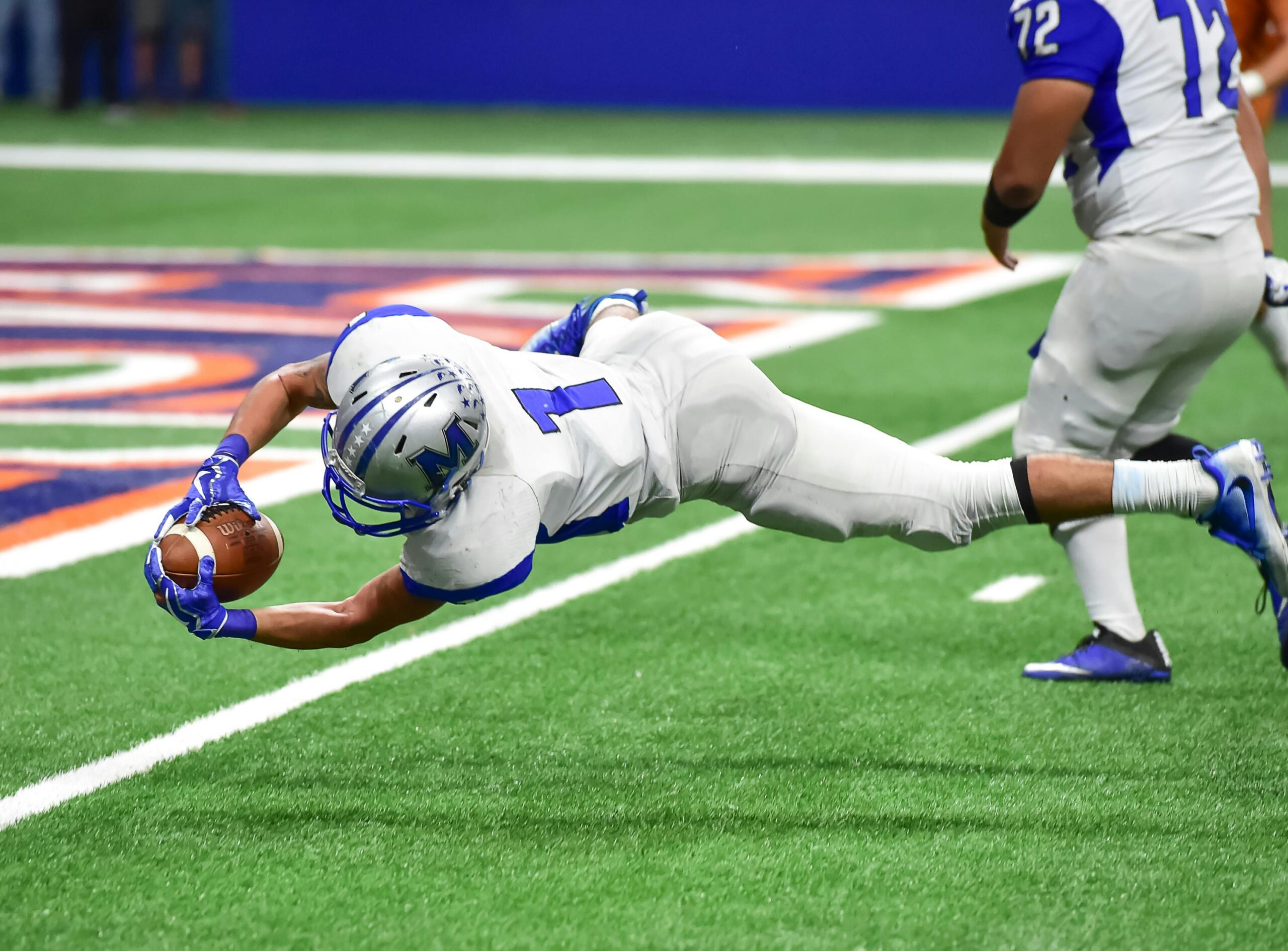
If you watch an average youth football game, most eyes are on the deep pass. It is natural that everyone wants to see the 50-yard bomb. But if you analyze the best red zone targets and quarterbacks in the world, players like Patrick Mahomes, Cooper Kupp, or Travis Kelce, you will notice they play a different game inside the 20-yard line.
They are constantly adjusting their leverage, shortening their routes, and preparing for intense physical contact before the ball is even snapped.
At Athletes Untapped, we emphasize a core concept to every offensive player we train: the field shrinks in the red zone, which means your margin for error disappears.
For an offense, a massive percentage of scoring relies on execution in compressed spaces. Yet, most young athletes spend the majority of their training time perfecting open-field moves. While those skills are vital, football red zone execution is the silent skill that separates average teams from elite scoring machines. It is the difference between settling for a field goal and punching in a touchdown.
In this guide, we are going to break down why the short field is your ultimate test, the specific drills AU coaches use to sharpen it, and how to fix the common mistakes seen on the gridiron every weekend.
Connect with a Private Football Coach: https://athletesuntapped.com/browse/football/
Why Football Red Zone Execution Matters for Offenses
Great red zone play isn’t just about running hard; it is about running smart. You can march 80 yards down the field and never score if your timing is wrong. Here is why elite execution changes your game:
Capitalizing on Drives: Most scoring stalls happen because a player panics under tight coverage. By understanding spatial geometry, you buy yourself the extra inch needed to make a catch, turning three points into seven points.
Breaking Man Coverage: A well-timed rub route or sharp cut can split a tight defense wide open. It turns a heavily guarded area into an immediate goal-scoring threat.
Being the Finisher: The red zone is the bridge between a good drive and a victory. If you hesitate, that bridge collapses, and your team loses all momentum.
Dictating Play: When you know how to use the back of the end zone as an extra player, you don’t force the ball, the openings come to you.
Best Football Red Zone Execution Drills for Offenses
These aren’t just physical drills; they are cognitive drills. We are training the brain to process tight spaces and the body to react with leverage.
1. The High-Point Fade Drill
The Setup: Align a wide receiver and a quarterback at the 5-yard line. Place a tall pad or cone in the back corner of the end zone.
The Action: The receiver runs a fade route toward the back pylon. The quarterback throws a touch pass to the highest point. The receiver must jump, secure the ball at its apex, and tap both feet in bounds.
Why It Works: It forces you to win the contested battle. In compressed spaces, you cannot outrun a defender; you must out-jump them.
Coaching Cue: Go get it at the peak! Do not wait for the ball to come down to your chest.
2. The Slant-and-Shield
The Setup: Start at the 10-yard line with a receiver and a defensive back.
The Action: The receiver plants hard on their outside foot, drives inside on a slant, and physically places their body between the defender and the incoming ball.
Why It Works: Defenders have less ground to cover in the red zone, so they play tighter. This teaches the receiver to use their frame as a shield so the defender cannot break up the pass.
Coaching Cue: Own your grass. Cut sharp and box them out like a rebound.
3. The Heavy Box Surge
The Setup: Create a 3-yard chute using bags. Line up an offensive lineman against a defensive lineman.
The Action: On the snap, the offensive lineman must stay incredibly low, fire their hands inside, and drive the defender backward for exactly two yards while a running back follows.
Why It Works: It punishes standing up. If you pop up out of your stance on the goal line, your forward progress is cut off immediately.
Coaching Cue: Low man wins. Fire off the ball and keep your feet driving.
4. The Back-Line Scramble
The Setup: Quarterback starts at the 15-yard line. Receivers run their initial routes into the end zone, and the coach blows a whistle to simulate a broken play.
The Action: The quarterback rolls out of the pocket. Receivers must instantly break their routes and work horizontally along the back line of the end zone to provide an open target.
Why It Works: It breaks the habit of giving up on the play. When passing angles break down near the goal line, the team that keeps moving finds the open grass.
Coaching Cue: Never stop moving. Slide with the quarterback and stay in bounds!
5. The Pylon Race
The Setup: A running back takes a handoff at the 5-yard line and sprints toward the front pylon while a defender pursues from an inside angle.
The Action: The ball carrier must secure the ball in their outside arm, absorb the contact, and reach the ball just inside the pylon before stepping out of bounds.
Why It Works: It teaches the exact geometry of scoring. You do not need your whole body in the end zone, just the tip of the football.
Coaching Cue: Protect it with the inside shoulder, reach with the outside hand!
Common Mistakes Athletes Make
Our coaches see these errors in almost every youth game, from pee-wee to high school varsity.
Forcing the Hero Ball: Quarterbacks want to make the big play, so they throw into triple coverage in the middle of the end zone. Learn to throw the ball away to live for the next down.
Running Out of Space: Receivers running their standard 15-yard deep routes when the ball is snapped on the 10-yard line. You must shorten your route depths to open a passing lane.
The Spectator Mode: Offensive linemen blocking for two seconds and then stopping to watch the running back. On the goal line, your job isn’t done at contact; you must drive until the whistle blows.
High Pad Level: Linemen and running backs standing straight up at the snap. Effective short-yardage movement involves playing lower than the defense to initiate the contact.
How Private Coaching Accelerates Improvement
Red zone execution is arguably the hardest skill to learn in team practice. Why? Because a team coach has 22 players to watch during an 11-on-11 scrimmage. They can’t stop the drill every 10 seconds to tell one receiver that they rounded off their slant cut. This is where private coaching is a cheat code for development.
A private football coach can:
- Fix Your Route Depths: We measure exactly where you make your cuts and drill it until your spatial awareness becomes muscle memory.
- Teach Leverage Mechanics: We work on your pad level and hand placement so you can win the physical battles, a detail often missed in team drills.
- Video Analysis: Sometimes you need to see yourself drifting out of bounds to understand it. Private coaches can break down your game film.
- Build Confidence: When you know exactly how to use your body in tight spaces, you stop panicking. You start demanding the ball near the goal line.
Find a Private Football Coach: https://athletesuntapped.com/browse/football/
Frequently Asked Questions about Football Red Zone Execution
What exactly is red zone execution?
It refers to the offensive strategy and physical mechanics used when the team is inside the opponent’s 20-yard line. This includes shortening routes, playing with lower pad level, and making faster decisions due to the compressed space.
How can I improve my spatial awareness as a receiver?
You must treat the boundaries like an extra defender. Practice running routes right along the sideline or back line of the end zone so you instinctively know where your feet are without looking down.
At what age should players learn goal-line tactics?
Basic concepts like getting low and protecting the football can be taught as early as 8 years old. By age 12 to 14, players should be learning more complex movements like pick routes and back-line scrambles.
Can you practice red zone situations alone?
Yes, but it requires discipline. Use cones to outline the end zone and practice your route cuts with exact precision. Visualize the defender and the tight throwing windows.
Do private coaches teach red zone mechanics?
Absolutely. In fact, it is one of the most common requests we receive. Private sessions allow us to isolate your footwork and timing without the chaos of a full scrimmage, ensuring the player understands exactly how to win in tight spaces.
Conclusion
Becoming a dominant red zone threat isn’t just about who is the fastest or who can throw the furthest. It is about intelligence, leverage, and the willingness to be physical when the field shrinks.
The best offenses are the ones who make scoring look easy because they have already done the hard work, adjusting their depths, practicing their high-point catches, and mastering leverage, before the ball is even snapped.
Start applying these drills. Focus on your pad level. Be the player your team trusts to finish the drive.
About Athletes Untapped
Athletes Untapped connects football players with experienced private coaches who specialize in tactical movement and game IQ. Through personalized instruction and structured training plans, Athletes Untapped helps offensive players improve spatial awareness, leverage, and scoring ability.
Find an experienced coach near you: https://athletesuntapped.com
Learn from our very best Coach!


