
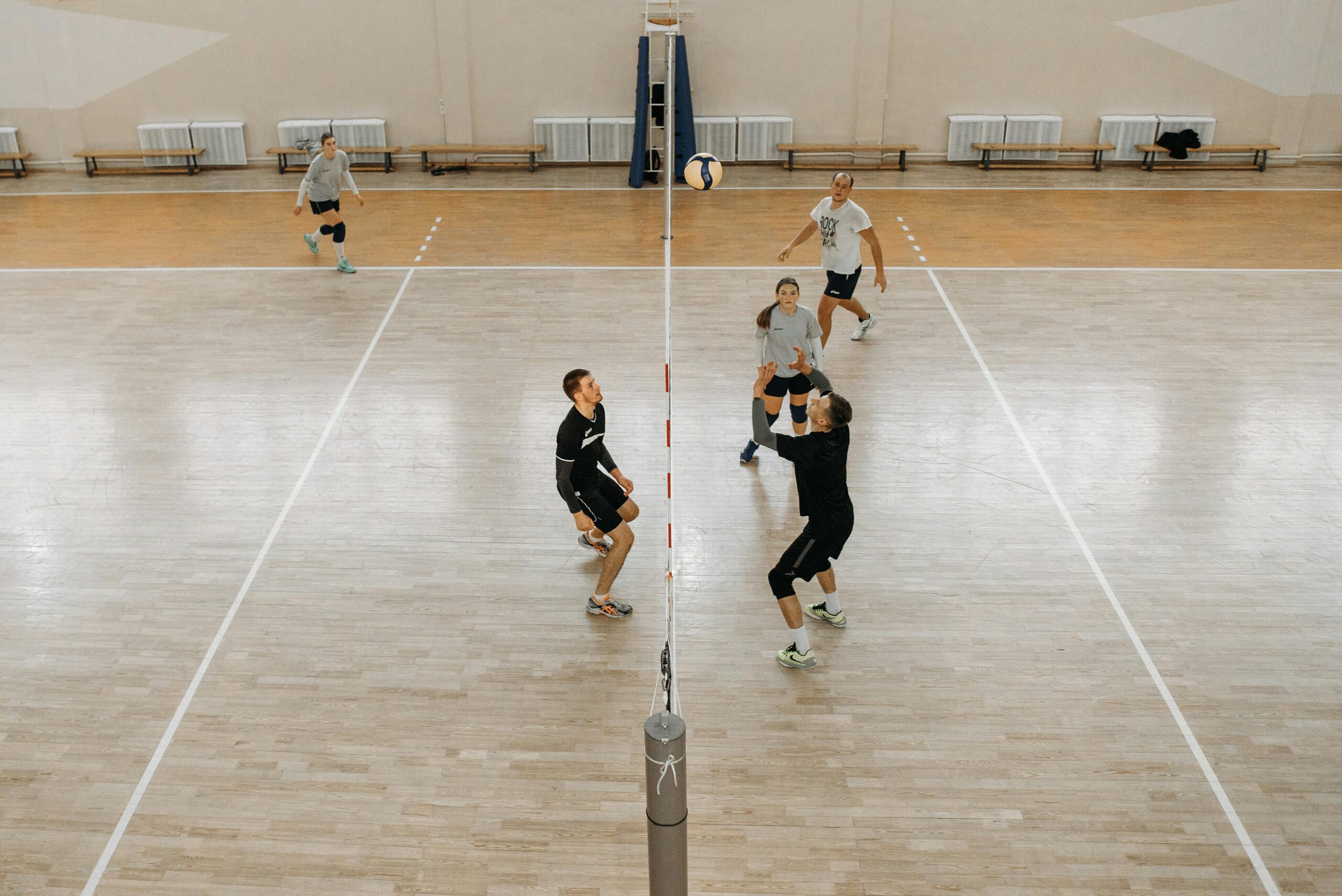
In volleyball, diving to the floor to dig a 60 mph spike looks like an act of superhuman reflexes, but the truth is that elite defense has very little to do with raw reaction time. The court is too small, and the ball moves too fast for the human brain to simply wait for the hit and then react. If you are waiting for the ball to cross the net before you decide how to move, you have already lost the point.
At Athletes Untapped, AU coaches notice that many young defensive specialists and liberos treat defense like a guessing game. They lock their feet into the floor, stare exclusively at the volleyball, and randomly dive into empty spaces hoping the hitter accidentally hits it right to them. This lack of structural vision leads to shanks, getting caught flat-footed, and a highly frustrating inability to keep the ball alive during crucial, fast-paced rallies.
The secret to keeping the ball off the floor lies in the read and react sequence. Proper training fixes these visual processing issues, allowing players to decode the setter’s body language, track the hitter’s approach angle, and establish perfect defensive positioning before the ball is even struck.
Connect with a Private Volleyball Coach: https://athletesuntapped.com/browse/volleyball/
Why This Skill Matters for Athlete Development
Your ability to read the game dictates your defensive range. Without anticipatory vision, you are limiting your defensive impact to the three-foot radius directly around your body.
- Game Performance: Elite reading directly translates to effortless defense. When you understand how to look through the net and align yourself outside the block, you stop making desperate, flailing dives. You force the hitter to swing into your platform, turning an opponent’s best offensive weapon into a perfectly passed transition ball for your setter.
- Confidence: AU coaches have seen athletes improve faster when they spend just 10 focused minutes on visual tracking drills at the start of every session. When decoding the hitter’s shoulder angle becomes muscle memory, defenders stop feeling anxious about hard-hitting teams. They gain the composure to hold their ground, trust their pre-snap read, and execute a confident, quiet platform upon contact.
- Long-Term Development: As you progress to high school, club, and collegiate volleyball, offenses become incredibly deceptive, utilizing quick tempos, slides, and setter dumps. A biomechanically and cognitively sound understanding of visual cues protects you from being easily fooled by misdirection. It provides the elite tactical IQ needed to anchor a back row, ensuring your value scales as you face faster, smarter setters.
Best Drills / Tips / Techniques
You cannot master defensive reading by simply having a coach stand on a box and hit balls directly at you. You need isolated, cognitively demanding scenario drills to train your eyes where to look and your feet when to stop. Here are 5 techniques AU coaches use to build an unshakeable back-row defender.
1. The Eye-Sequencing Drill (Ball, Setter, Ball, Hitter)
How to perform it: Stand in middle-back defense. As the opposing team passes the ball, loudly call out your visual sequence: say “Ball” as it is passed, “Setter” as the setter prepares to set, “Ball” as it is set to the pin, and “Hitter” as the attacker takes their approach.
Why it works: Amateur defenders get mesmerized by watching the ball float through the air. This drill forces the brain to manually shift focus to the human beings making the decisions. By looking at the hitter’s approach instead of the ball, you instantly know whether they are hitting crosscourt, line, or tipping.
Coaching tips: The most critical read is the “Hitter” phase. Look at their shoulders. A hitter will almost always swing the direction their chest and hitting shoulder are facing at the apex of their jump.
Common mistakes: Staring directly at the volleyball for the entire sequence. The ball cannot change directions on its own; the hitter dictates the direction. Watch the hitter.
2. The Split Step Timing
How to perform it: As the opposing hitter begins their arm swing, take a tiny, rhythmic hop. Your feet must land flat on the ground in a wide, athletic stance the exact millisecond the hitter makes contact with the ball.
Why it works: You cannot move explosively if your momentum is traveling in the wrong direction, or if your heels are stuck to the floor. The split step acts as a plyometric trigger. It ensures your body weight is perfectly balanced and your muscles are loaded with elastic energy, allowing you to instantly push off in any direction.
Coaching tips: Do not jump high into the air. It is a subtle resetting of the feet, keeping your shoes practically brushing the hardwood.
Common mistakes: Stopping completely still too early, or still moving backward when the ball is hit. If you are moving when contact is made, you will shank the dig.
3. Reading Around the Block (The V-Vision)
How to perform it: Set up a double block on the net. As a back-row defender, you must physically position yourself so that you can clearly see the hitter’s face and hitting arm outside the shadow of your own blockers. If you cannot see the hitter, the hitter cannot hit to you.
Why it works: The block is your first line of defense; your job is to cover the space the block cannot protect. This drill trains spatial geometry. It teaches defenders to use their own blockers as a shield, funneling the attack directly into the digging lanes.
Coaching tips: Trust your blockers. If they are taking away the line, you must heavily commit to the crosscourt angle. Do not try to cover the space your block is already taking.
Common mistakes: Hiding behind your own blockers. If you are looking at the backs of your teammates’ jerseys, you are mathematically useless to the defense.
4. The “Low to Lower” Posture Drill
How to perform it: Start in your standard defensive posture with your knees bent and your chest forward. As the setter releases the ball to the hitter, drop your hips two inches lower. As the hitter begins their downward arm swing, drop your hips another two inches lower, bringing your center of gravity incredibly close to the floor.
Why it works: A hard-driven spike takes less than half a second to hit the floor. If you start in a high stance, gravity will not let you drop to the floor fast enough to dig a downward-angled hit. This drill enforces a progressively lower base, ensuring your platform is already underneath the trajectory of the ball.
Coaching tips: Drop your hips, do not just bend at the waist. If your chest falls forward to your knees, you will lose your balance and fall on your face.
Common mistakes: Popping up. Many defenders naturally stand up slightly right before the hitter makes contact due to tension. You must actively fight this instinct and stay rooted to the floor.
5. The Chaos Touch Drill
How to perform it: Three defenders start in the back row. A coach stands on the opposite side of the net and randomly attacks, tips, or throws the ball off the top of the block tape to create unpredictable deflections. The defenders must read the chaotic trajectory and keep the ball alive, calling “Mine!” aggressively.
Why it works: Perfect reads do not always lead to perfect defensive scenarios. Blocks touch the ball, and hitters mishit the ball. This drill marries the initial read with extreme chaotic reaction, teaching defenders to stay light on their feet and adjust their platform angle in a fraction of a second.
Coaching tips: Keep your platform detached from your body until the absolute last second. If you lock your arms together too early, you cannot run or adjust to a deflection.
Common mistakes: Freezing when the ball hits the block. You must expect the ball to be deflected on every single play.
Common Mistakes Athletes Make
Defensive reading errors are incredibly common in youth and high school volleyball, largely due to visual indiscipline and heavy footwork.
Guessing Early: Moving to a specific spot on the floor before the ball is even set, simply because you have a “feeling” the ball will go there.
How to fix it: Read, don’t guess. Let the sequence unfold. Move based on the setter’s body position, then adjust based on the hitter’s approach angle. Guessing leaves massive holes in the defense.
Swinging the Platform: Reading the ball correctly but wildly swinging the arms upward to dig it, causing the ball to fly backward over your head.
How to fix it: The read gets you to the spot; the angle does the work. Once you beat the ball to the spot, freeze your platform and let the speed of the spike do the work for you.
Standing Up on Tips: Playing great low defense for a hard spike, but standing straight up and reaching with your hands when the hitter decides to tip the ball short.
How to fix it: Stay low and pursue. You must run through the tip with your legs and play it with an underhand platform or a sprawling pancake, rather than standing up and trying to overhand pass it.
How Private Coaching Accelerates Improvement
Reading and reacting in volleyball is a highly cognitive skill that relies entirely on microscopic visual cues. Trying to self-diagnose whether your split step was a tenth of a second late, or if you were hiding behind the block on a crosscourt read, is incredibly difficult during a rapid-fire rally.
This is where private coaching is essential. Private coaching provides faster tactical development by utilizing expert eyes, slow-motion video analysis, and highly controlled hitting scenarios. A private volleyball coach offers personalized feedback tailored to your specific defensive posture, making it easy to catch habits like standing up early immediately. This targeted instruction allows athletes to focus on correcting their visual sequencing safely before bad habits become ingrained. Ultimately, mastering your defensive reads in a 1-on-1 environment provides massive confidence building, allowing you to step onto the court knowing you have the tactical IQ to dig the hardest hitters in your league.
Find a Private Volleyball Coach: https://athletesuntapped.com/browse/volleyball/
Frequently Asked Questions about Defensive Reading in Volleyball
Where should my eyes be looking when the other team passes the ball?
Your eyes should follow a specific sequence: watch the ball off the passer’s platform, instantly shift your eyes to the setter’s hands and body position, track the set briefly, and then lock your eyes onto the hitter’s approach and shoulder angle.
How do I know if the hitter is going to tip the ball?
Look at their elbow and hand speed. A hitter preparing for a hard spike will have a fast, violent arm swing with a high elbow. A hitter preparing to tip will often drop their elbow slightly and slow down their hand speed significantly right before contact.
Why do I keep digging the ball straight into the ceiling?
You are likely leaning backward on your heels when making contact, or your platform is angled too high. Keep your weight forward on the balls of your feet and angle your platform toward the setter’s target.
What is the difference between rotational defense and perimeter defense?
Perimeter defense relies on defenders staying deep near the lines and reading the hitter’s angle. Rotational defense involves specific defenders moving up to cover short tips or sharp crosscourt angles based on where the ball is set. Your read mechanics apply regardless of the system your team uses.
Do private coaches help with this?
Absolutely. Private volleyball coaches are essential for breaking down the biomechanics of the split step, providing live-arm hitting to practice your shoulder reads, and isolating specific posture flaws so you can become a vastly more reliable defender.
Conclusion
Mastering the read and react sequence is the undeniable foundation of a relentless, frustrating-to-play-against defensive specialist. Without it, you are leaving your back-row success entirely to chance and playing directly into the hands of intelligent setters and powerful hitters. Improvement is highly achievable with proper visual training, but it requires extreme cognitive discipline, a low center of gravity, and a willingness to trust your eyes over your instincts. Encourage yourself to focus on your eye sequencing and your split-step timing before you focus on flashy diving, and consistent practice will inevitably yield a quiet platform and a defense that absolutely refuses to let the ball drop.
Train With a Private Volleyball Coach
- Athletes Untapped connects athletes with vetted private coaches across the country for one-on-one training.
- Private coaching helps athletes:
- improve faster
- build confidence
- receive personalized feedback
- reach their full potential
About Athletes Untapped
Athletes Untapped connects volleyball players with experienced private coaches who specialize in defensive positioning, visual reading, and back-row mechanics. Through personalized instruction and structured training plans, AU coaches help liberos and defensive specialists eliminate guessing, master their footwork timing, and completely lock down the backcourt.
Find an experienced coach near you: https://athletesuntapped.com
Learn from our very best AU coaches!


