
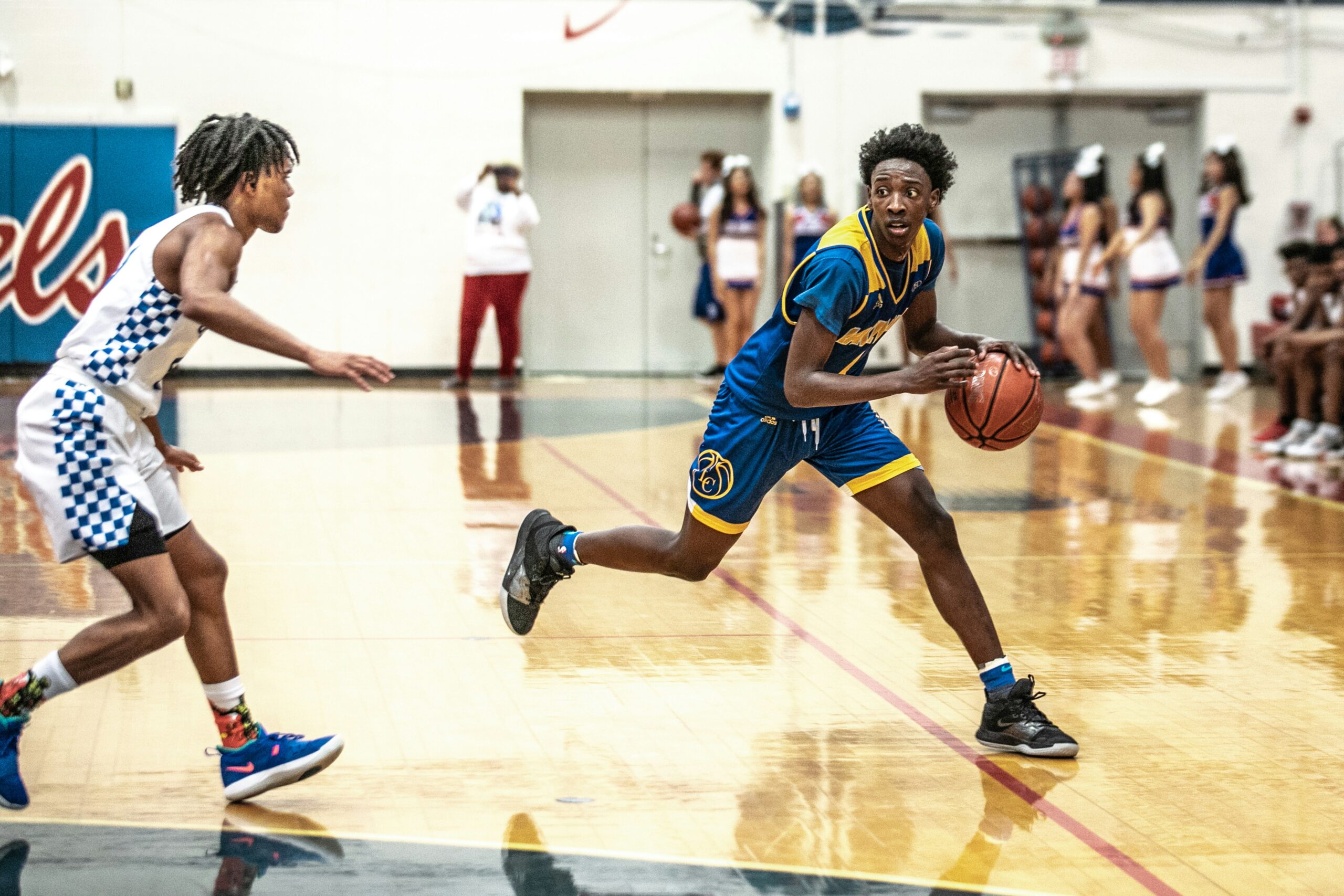
Spend enough time around youth basketball and you’ll hear coaches say, “Get in triple threat!” constantly. For a new player, that instruction doesn’t mean much.
Triple threat is the ready position a player gets into after receiving the ball. From there, they can shoot, pass or dribble. The point isn’t to strike a perfect pose and stand there. It’s to catch the ball balanced, keep your eyes up and be ready to make the next play.
Jr. NBA defines triple threat as “an offensive position that leaves a player ready to pass, dribble or shoot”. USA Basketball also includes it as a foundational skill for developing young players.
For younger players, the challenge is usually less about understanding those three options and more about putting everything together at once. They have to catch the ball, control it, get their feet underneath them, look at the basket and figure out what to do next, and that takes practice.
What Should a Good Triple Threat Position Look Like?
There are different ways coaches teach the details, but the basic position is pretty consistent.
A player should be balanced with their knees bent and feet roughly shoulder-width apart. The ball should be secure near the body, usually around the waist or hip area, and the player’s eyes should be up.
USA Basketball teaches young players to hold the ball just above the waist with their fingers spread and their head up. Jr. NBA similarly describes the position as a balanced athletic stance with bent knees and the ball held securely toward the player’s dominant side.
One cue that tends to work well with kids is simply:
“Be ready to shoot, pass or go.”
That gives them something easier to remember than a long checklist about feet, knees, hands and elbows.
1. Start With Balance
Before worrying about jab steps or rip-through moves, make sure the player is actually balanced.
Young players often catch the ball standing straight up with their feet close together. That makes almost everything that comes next harder.
Instead, have them land in an athletic position with their knees bent and their weight under control. They should feel like they could move in either direction without having to reset their feet first.
2. Keep the Ball Strong
The ball shouldn’t be dangling away from the body where a defender can easily reach it.
Have the player hold it securely with both hands while still leaving enough room to move it into a pass, shot or dribble.
As players become more comfortable, you can teach them to move the ball from one side of their body to the other to protect it from a defender. Jr. NBA includes high and low “rip” movements in its triple threat drills for young players.
3. Eyes Up
This is one of the easiest pieces to overlook.
A player who immediately looks down at the basketball can’t see an open teammate, an open lane or the defender in front of them.
When a player catches the ball, encourage them to see the court before deciding what to do.
You don’t need to make this complicated for a seven-year-old. “Catch and look” is often enough.
A Quick Note About the Pivot Foot
This is an area where youth players, and sometimes adults, get confused.
There is no rule that says a right-handed player always has to use their right foot as the pivot foot.
The pivot foot is established based on how the player receives the ball and comes to a stop.
If a player catches the ball while standing with both feet on the floor, they can establish either foot as the pivot foot. Once one foot is lifted, the other becomes the pivot. If they receive the ball and land on one foot first, that first foot may become the pivot depending on the situation.
FIBA’s coaching materials specifically encourage players to understand which foot is their pivot foot rather than simply assigning the same foot every time. USA Basketball also includes pivoting on both the right and left foot as an important youth basketball skill.
For beginners, the most useful rule to teach is this:
Once you establish your pivot foot, don’t move it before you start your dribble.
If the player wants to dribble, the ball needs to leave their hand before the pivot foot comes off the floor. That little detail prevents a lot of the traveling calls you see in youth games.
Common Triple Threat Mistakes With Young Players
Most kids make the same handful of mistakes while they’re learning.
Dribbling Immediately
This may be the biggest one.
Some young players catch the ball and automatically start bouncing it, even when they aren’t going anywhere.
Triple threat gives them another option. They can catch, look at the floor and then decide whether a pass, shot or dribble makes sense.
You don’t want players standing still forever, but you also don’t want the dribble to become an automatic reaction every time they touch the ball.
Standing Straight Up
A player with locked knees and narrow feet isn’t ready to do much.
Instead of repeatedly saying “bend your knees,” try showing players the difference. Have them stand tall while you give them a small push at the shoulder. Then have them get into an athletic stance and try again.
They’ll usually feel the difference immediately.
Looking at the Ball
Players who are still developing ball confidence tend to watch the basketball constantly.
During basic triple threat work, remind them that the ball isn’t going anywhere. They can keep their head up and look at the basket, defender and teammates.
Holding the Ball Away From the Body
Young players sometimes hold the ball out in front of them like they’re presenting it to the defense.
Teach them to keep it strong and protected.
Once they get comfortable doing that without pressure, add a passive defender so they learn how the position feels with someone standing in front of them.
Forgetting Their Pivot Foot
This usually shows up once players start trying to attack.
They catch, move one foot, move the other foot and then start their dribble.
Slow the movement down and let them practice pivoting before adding speed. Once the footwork is comfortable, work back toward game pace.
Four Triple Threat Drills for Youth Players
You don’t need an elaborate practice setup to work on this skill.
A few minutes at a time is usually more useful than spending half of practice standing in a line doing triple threat repetitions.
1. 1-2-3 Triple Threat
This is based on a drill Jr. NBA uses in its youth practice plans.
Give every player a basketball and let them dribble around the half court.
Call out:
“1, 2, 3!”
Players stop, gather the ball and get into triple threat.
Check for:
- Balanced feet
- Bent knees
- Strong grip on the ball
- Eyes up
Then yell “Go!” and have everyone begin dribbling again.
Once they understand the drill, add a rip-through before they start moving.
It’s simple, quick and works especially well with younger teams.
2. Catch, Triple Threat, Go
Pair players up.
One player passes the ball. The other catches it, gets into triple threat and reacts to the coach’s call.
Call:
“Pass!”
They return the pass.
“Shot!”
They go into their shooting motion.
“Go!”
They take a strong first dribble.
You can run the drill slowly at first, then shorten the amount of time between the catch and your instruction.
The goal isn’t just learning the stance. It’s learning how quickly a player can move out of it.
3. Add a Defender
Once a player looks comfortable without pressure, put a defender in front of them.
Start with a passive defender who isn’t allowed to steal the basketball.
The offensive player catches, gets into triple threat and keeps the ball protected while reading the defender.
You can then let the defender become progressively more active.
That progression matters. Asking a beginner to learn new footwork while another player is aggressively trying to steal the basketball usually turns the drill into chaos.
4. Give Them a Decision
This is where triple threat starts becoming basketball instead of a technique drill.
Set up one offensive player with the ball, one defender and possibly a teammate.
Then change the situation.
Have the defender back up. Can the player shoot?
Have the defender crowd them. Can they attack the basket?
Have a teammate get open. Can they make the pass?
Don’t tell the offensive player which option to choose before the play starts.
Let them decide.
For younger players, even a very simple two-on-one situation can teach more than repeatedly practicing a stance with no defense involved.
Don’t Overcoach the Position
There are plenty of details you can add as players get older: jab steps, shot fakes, rip-throughs, front pivots, reverse pivots and different ways to attack a defender.
A beginner doesn’t need all of those things at once.
Give them one or two corrections, let them try again and keep the drill moving.
Research and youth coaching guidance consistently support giving athletes specific, usable feedback rather than simply pointing out everything they did wrong. Rutgers’ Youth Sports Research Council recommends telling young athletes what to do differently and adjusting instruction to their age and ability level.
So instead of:
“No, you’re doing it wrong. Stop standing up.”
Try:
“Get a little lower so you’re ready to drive.”
Instead of:
“Don’t look down.”
Try:
“Find the rim when you catch it.”
Those are directions a kid can actually use on the next repetition.
The Goal Isn’t a Perfect Stance
Triple threat is important, but the stance itself isn’t really the end goal.
You’re teaching a young player to receive the ball under control and recognize that they have options.
Can I shoot?
Is someone open?
Can I attack the defender?
That decision-making becomes much more important as players develop.
USA Basketball’s youth development curriculum treats triple threat as part of a larger progression that includes passing, shooting, dribbling, pivoting and eventually using those skills at game speed.
That’s a much better way to think about it than expecting kids to hit a textbook pose every time they catch the basketball.
Teach the position. Practice it often. Then put players in situations where they actually have to use it.
That’s when it starts to stick.
Want Some Extra Help With Basketball Fundamentals?
Sometimes a player understands what their team coach is asking but needs more repetitions or individual attention to put it together.
Athletes Untapped connects young basketball players with experienced private coaches for one-on-one training focused on the areas they need most, whether that’s footwork, ball handling, shooting, confidence or learning how to make better decisions with the ball.
Find a private basketball coach near you through Athletes Untapped.


