
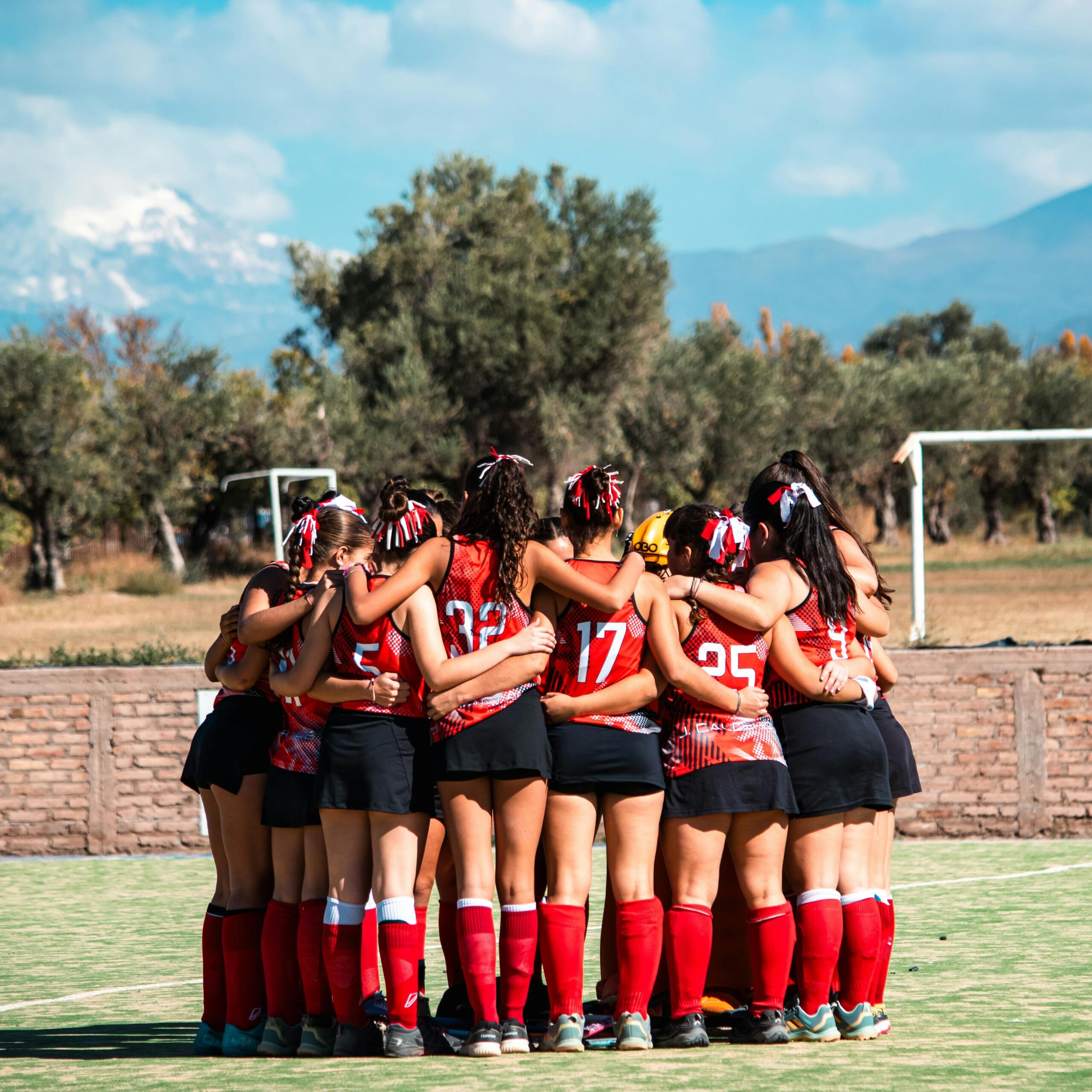
Field hockey moves too quickly for players to rely on memorized plays alone.
A midfielder receives the ball with pressure coming from one side. A defender steps forward and leaves space behind. Possession changes and suddenly the entire team has to shift from attacking to defending before the opponent can take advantage.
Those moments are where game strategy really lives.
Formations and set plays matter, but good field hockey strategy is mostly about recognizing space, understanding where teammates are, and making the right decision quickly enough for everyone to stay connected.
For players, that means learning more than where to stand, it means understanding why you’re standing there and what should make you move somewhere else.
Start With Shape, Not Just a Formation
Coaches might describe a team as playing a 4-3-3 or another formation, but field hockey doesn’t stay frozen in that shape once the ball starts moving, and players have to adjust constantly.
When your team has possession, the field should usually become bigger. Players spread out to create passing lanes and force defenders to cover more space.
When the opponent has the ball, the team often becomes more compact so the spaces between defenders and midfielders are harder to play through.
That movement is more important for developing players than memorizing a formation diagram.
- A midfielder should understand when to come toward the ball and when doing so would simply bring another defender into the same space.
- A forward should know when staying wide opens a lane through the middle.
- A defender should recognize when stepping forward to support possession is useful and when doing so would leave the team exposed behind the ball.
Those are positional decisions, but they’re really decisions about space.
One of the best questions a player can learn to ask is:
Where can I move that gives the player on the ball another option?
Possession Is About Creating the Next Pass
Young teams sometimes confuse possession with simply passing the ball around.
Good possession has a purpose.
The team is trying to move defenders, create space, and eventually find a better position from which to attack.
Sometimes that means playing forward immediately, and sometimes the smartest pass goes sideways or backward.
A defender who receives the ball under pressure may be much better off switching the point of attack than forcing a pass straight through a crowded midfield.
This is why players need to scan before receiving.
If the athlete waits until the ball reaches their stick before looking around, much of the useful information is already gone.
- Where is the pressure coming from?
- Which teammate is free?
- Is there space ahead?
- Would one touch into a different area create a better passing angle?
The technical skill and tactical decision aren’t separate.
Pressing Starts With a Plan
“Pressure the ball” is common defensive advice, but a successful press requires more than one player sprinting at whoever has possession.
The players behind the first defender have to understand what the pressure is trying to accomplish.
Maybe the team wants to force the opponent toward the sideline.
Maybe the goal is to block the central passing lane.
Maybe the team is willing to let one defender receive the ball because it creates an opportunity to trap the next pass.
The details vary by team, but everyone needs to recognize the same picture.
USA Field Hockey gave a good real-world example during its 2025 National Coaches Forum when U.S. Women’s National Team assistant coach Bert Remmerswaal discussed the team’s move toward a man-to-man press. Among the important pieces he identified were getting organized quickly, maintaining pressure on the ball, and having another defender positioned to deal with longer passes.
For younger players, you don’t need to copy an international team’s system.
Teach the basic idea.
- The first defender applies pressure.
- The next defenders take away useful passing options.
- The players behind them stay connected rather than watching the play develop from 20 yards away.
A press succeeds because several players are solving the same problem together.
Don’t Press Just Because You Can
Sometimes the smartest defensive decision is not to chase the ball.
If the team has lost its shape, sending another player forward may create even more open space.
Players need to learn when to delay.
Imagine an opponent collects the ball and has several teammates breaking forward. Instead of diving into a tackle, the nearest defender may slow the play down, stay between the attacker and the dangerous space, and give teammates time to recover.
That can be just as valuable as winning the ball immediately.
This is one reason tactical training should include real decisions rather than a drill where players already know exactly what will happen.
Small-sided games work especially well.
Play 3-on-3 or 4-on-4 in a limited area and suddenly every player has to defend, support, transition, communicate, and find space.
Transition Is Often Where the Best Opportunities Appear
Possession changes constantly in field hockey.
That first moment after winning or losing the ball can be one of the most important parts of the game.
When your team wins possession, the opponent may still be spread out in attacking positions.
Before they reorganize defensively, there may be space available.
The player who wins the ball should quickly assess:
Can we attack now?
If the answer is yes, move the ball before the defense resets. That doesn’t mean forcing the first forward pass available; a rushed turnover ends the opportunity immediately.
The goal is to recognize whether the team has an advantage.
When possession is lost, the thinking reverses: can the nearest players win the ball back quickly?
If not, the priority may become getting behind the ball and rebuilding defensive shape.
Players shouldn’t mentally separate the game into long stretches of “we are attacking” and “we are defending” because the change between the two may happen in a second.
Attacking Works Better When Players Create Space for Each Other
Attacking isn’t simply getting as many people toward the goal as possible.
Sometimes the most useful run is one that doesn’t receive the ball.
- A forward can pull a defender wide and create space for a teammate coming through the middle.
- A midfielder can make an overlapping run that gives the ball carrier another option.
- A player near the circle can lead away from the passing lane and open room behind them.
Young players naturally want to move toward the ball.
Good attacking players learn that sometimes moving away from it creates the better opportunity.
This is also why timing matters.
If three players all make the same run at once, the defense has an easy problem. If one player moves and forces a defender to respond, then another attacks the space that opens, the defense has to make a decision.
That is how teams create advantages.
Set up a 3-on-2 or 4-on-3 situation and let the players solve the problem.
Ask afterward:
Where was the space?
What made the defender move?
Was there another pass available?
You’re teaching players to recognize patterns rather than simply memorize routes.
Entering the Circle Should Have a Purpose
Teams can possess the ball beautifully and still struggle to score if they don’t understand what to do near the attacking circle.
Players need to recognize different ways to create a scoring chance.
- Sometimes there is space to carry the ball into the circle.
- Sometimes the better option is an early pass.
- Sometimes a baseline run creates an opportunity to send the ball across goal.
- Sometimes the defense is too compact and the team needs to recycle possession instead of forcing the ball through several sticks.
The important thing is that players don’t treat every circle entry the same way.
Once the ball enters the circle, off-ball movement becomes especially important.
Attackers should be giving the ball carrier useful options: at the far post, near the penalty spot, behind the play, or in another area dictated by the situation.
Standing next to a defender and waiting for the ball rarely creates much.
Penalty Corners Need Roles, Not Just a Fancy Routine
Penalty corners are one area where repetition and predetermined roles really do matter.
The injector, stopper, shooter, rebound players, and defensive runners all need to understand their jobs.
But youth teams don’t necessarily need six elaborate corner variations.
Start by executing one option well.
- Can the injector consistently deliver the ball where it needs to go?
- Can the receiving player control it?
- Can the shooter get the attempt away efficiently?
- Do the other attackers know where rebounds may appear?
Once those pieces become reliable, teams can add variations.
Set pieces have also become an increasingly specialized part of high-level hockey, and current FIH coach education continues to include tactical work around structured restarts and penalty corners.
Safety matters here too. Penalty-corner equipment rules have changed recently. FIH made face masks mandatory for field players defending penalty corners at FIH events in 2025, while U.S. high school rules have their own requirements and were revised again for the 2026 season.
Players and coaches should follow the rules that apply to their specific competition rather than assuming international, club, and high school procedures are identical.
Strategy Should Change When the Game Changes
A team shouldn’t necessarily play exactly the same way when leading by one goal late in the game as it did in the first quarter.
- Maybe protecting possession becomes more valuable.
- Maybe the press becomes less aggressive.
- Maybe the opponent has changed its buildup and your defensive plan is no longer stopping it.
Players should learn to notice those changes.
That doesn’t mean every athlete needs to become a tactical analyst in the middle of the game, even simple observations can matter:
Their right defender keeps carrying the ball forward.
Their midfield is leaving space wide.
We’re getting trapped every time we force the ball up the same sideline.
That information allows the team to adapt.
For younger players, the same idea can be simplified:
Watch what the opponent keeps doing and learn from it.
The Best Tactical Practice Still Looks Like Field Hockey
You can explain a press on a whiteboard, but eventually, players have to recognize it while someone is trying to dribble past them, and that’s why game-like training matters.
USA Field Hockey’s recent coaching forums have emphasized principles-based decision-making and training environments that resemble the actual problems athletes encounter during competition.
Instead of always telling players exactly where to pass, create a situation where they have options. Instead of running a defensive pattern against stationary opponents, let the offense try to break it. Instead of rehearsing an identical counterattack ten times, change where possession starts and let players decide whether to attack quickly or keep the ball.
Technical drills still have a place, players need time to improve passing, receiving, tackling, shooting, and individual skills, but tactical awareness grows when players use those skills to solve problems.
Individual Players Can Improve Their Tactical Awareness Too
Game strategy is obviously a team responsibility, but individual players can still work on becoming better decision-makers.
- A defender can learn when to step toward an attacker and when to delay.
- A midfielder can improve scanning and receiving under pressure.
- A forward can work on leading into space rather than waiting for the ball.
Those individual improvements make team tactics easier to execute.
Athletes Untapped connects field hockey players with private field hockey coaches who can work on technical skills, positioning, decision-making, and other parts of the game based on the athlete’s specific needs.
Private coaching won’t replace learning a team’s system, but it can help a player understand the game well enough to execute that system more effectively.
Ultimately, good field hockey strategy isn’t about memorizing the most complicated formation, it’s about seeing what’s happening, understanding where the space is, and making the next decision a little faster than the opponent.


