
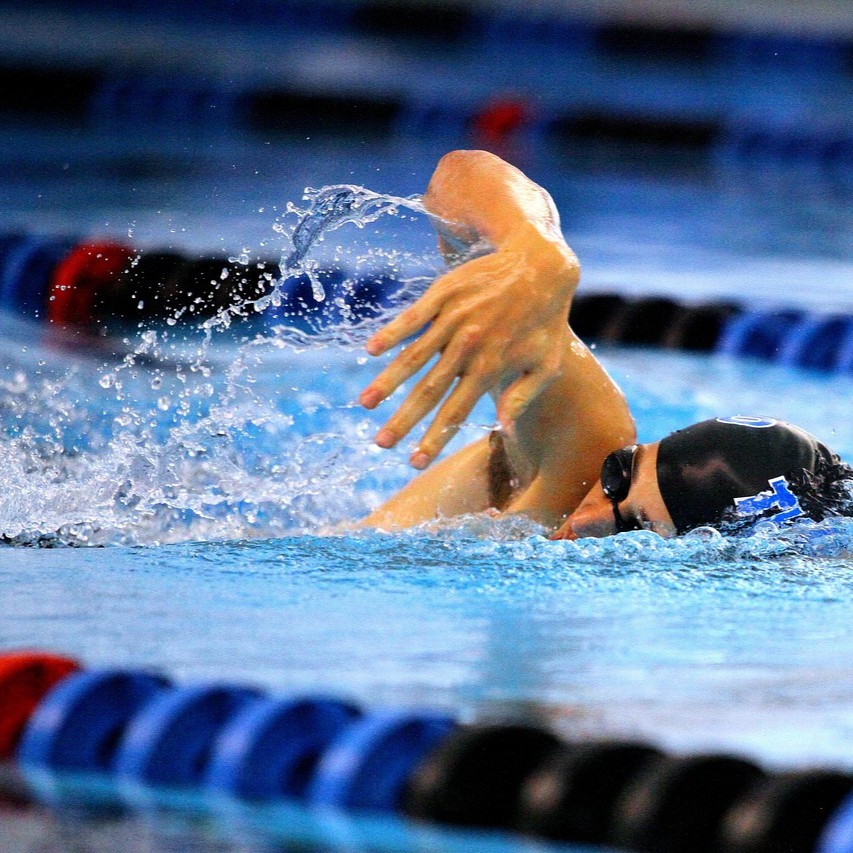
Swimming has a way of making even very fit athletes feel surprisingly tired.
Part of that is because the sport asks the entire body to work while moving through resistance, controlling breathing and trying to maintain efficient technique. A swimmer can be strong on land or have excellent general cardiovascular fitness and still struggle to hold stroke quality over the final part of a race.
That is why conditioning for swimmers has to be more specific than simply “getting in better shape.”
Most Swimming Conditioning Still Happens in the Pool
Dryland training gets a lot of attention, but swimmers still get most of their sport-specific conditioning from swimming.
That matters because fitness in swimming isn’t just about the heart and lungs, an athlete also has to maintain stroke length, stroke rate, body position, turns, underwater work and breathing patterns as fatigue increases.
A swimmer might be able to complete a long aerobic set but lose efficiency badly once the pace gets faster. Another may have plenty of endurance but struggle to produce enough speed for shorter events.
Good swim training develops those qualities at different intensities.
Longer aerobic work can help build the ability to sustain swimming over time. Threshold sets challenge swimmers to hold a stronger pace. Race-pace training gets more specific to the speed and demands of competition, while short maximum-effort work develops sprint capacity.
Technique Still Matters When You’re Tired
One reason conditioning is so closely tied to swimming performance is that fatigue can change how an athlete moves through the water.
A swimmer who starts dropping the elbow, shortening the stroke or losing body position may technically still be completing the workout, but they aren’t necessarily practicing the movement they want to reproduce in a race.
USA Swimming’s more advanced developmental benchmarks specifically include maintaining technique as training loads increase and understanding the relationship between stroke rate, distance per stroke and swimming speed.
That makes conditioning and technique difficult to separate completely.
Sometimes a swimmer needs greater aerobic capacity. Sometimes the bigger problem is that their stroke becomes inefficient once they’re tired. Often, both are involved.
This is one of the reasons coaches monitor more than simply whether an athlete finished a set. Pace, stroke count, technique and how consistently the swimmer can repeat efforts can all provide useful information.
For younger swimmers especially, piling on training volume before they can consistently maintain good movement may not be the best use of practice time.
Strength Training Can Support Swimming Performance
Dryland strength training can have a legitimate place in a swimmer’s program.
Studies involving experienced swimmers found that programs combining swimming with strength training generally produced better swimming-performance improvements than swim training alone. The researchers did not find one clearly superior type of strength training, which is a useful reminder that there isn’t a single “best swimmer workout.”
A newer meta-analysis also found that appropriately programmed resistance training improved upper-body strength and performance across several short- and middle-distance freestyle events in competitive swimmers.
That doesn’t mean swimmers should simply try to get as strong as possible in the weight room, but that dryland should support what happens in the pool.
Depending on the athlete, that may mean developing general strength through squats, hinges, pushes, pulls and carries. It could include jumping and power work for starts and turns, trunk strength for maintaining body position, or targeted shoulder work.
Shoulder Training Deserves More Thought Than “Get Stronger”
Competitive swimmers perform an enormous number of overhead repetitions, so it isn’t surprising that shoulder problems receive so much attention in the sport.
But injury prevention isn’t as simple as strengthening the shoulders and stretching more.
For swimmers, the practical lesson isn’t “do more shoulder exercises”, it’s that dryland programming should account for the enormous amount of work the shoulders are already doing in the pool.
Exercises for the upper back, scapular muscles, rotator cuff and trunk may be appropriate depending on the swimmer, but workload and technique matter too. Persistent shoulder pain isn’t something to simply strengthen through. It should be evaluated by an appropriate sports medicine professional.
Conditioning should help an athlete tolerate the demands of swimming, it shouldn’t simply add another large training load on top of them.
Mobility Matters, but More Flexibility Isn’t Always Better
Swimmers do need enough mobility to move efficiently through their strokes, starts and turns, but that doesn’t mean the goal is to become as flexible as possible.
Shoulders in particular need a combination of mobility and control. A swimmer may have plenty of range of motion but lack the strength or stability to control it well.
Ankle mobility can also matter for kicking and streamlining, while hip and thoracic mobility may influence different strokes and positions.
The useful question isn’t “How flexible is this swimmer?”
It’s “Does the swimmer have the movement they need for their stroke, and can they control it?”
Sprinters and Distance Swimmers Shouldn’t Condition Exactly the Same Way
A 50 freestyle is not a shorter version of the 1,500. The events place different demands on the athlete, and training should eventually reflect that.
A distance swimmer needs the ability to sustain a strong pace efficiently over a long period. A sprinter needs to produce very high speed and power while maintaining technique over a much shorter effort. Middle-distance swimmers live somewhere between those extremes.
That doesn’t mean a sprinter never does aerobic work or a distance swimmer never sprints.
A well-developed swimmer needs a broad fitness base.
As athletes become more advanced, though, the balance should become more specific to their events. That is also why copying another swimmer’s workout from social media isn’t particularly useful without context.
A set that makes perfect sense for a collegiate 100-meter specialist may be completely inappropriate for a 12-year-old developing distance skills.
Conditioning Should Fit Around the Entire Swim Week
Another common mistake is treating dryland as if it exists separately from swim practice.
If a swimmer has a very demanding pool session in the afternoon, an exhausting strength workout that morning may affect the quality of the swim. If the team is in a heavy competition period, the dryland workload may need to look different from an early-season training block.
Sometimes the swimmer needs another hard training stimulus. Sometimes they need enough recovery to actually adapt to the work they’ve already done.
This is also why cross-training shouldn’t be added just because it sounds like a good conditioning tool. Running or cycling can be useful in certain circumstances, but swimmers aren’t required to accumulate extra cardio simply because they’re athletes.
If the swimmer already has a high pool workload, another endurance session may offer less value than strength work, mobility, recovery or simply rest.
Younger Swimmers Need Athletic Development, Not Just More Laps
For children, conditioning should look different.
USA Swimming’s early developmental stages emphasize play, basic motor skills and participation in different activities before progressing toward more structured dryland training. Young swimmers are encouraged to develop skills such as jumping, throwing, catching, hopping and skipping rather than becoming narrowly focused on swimming-specific exercises immediately.
That broader athletic development has an important place.
A young swimmer doesn’t need every minute outside the pool to be devoted to bands and “swimmer-specific” exercises. Running around, jumping, playing another sport and learning general body control can all contribute to becoming a better athlete.
As swimmers mature, training can become more structured and specific.
The progression should follow the athlete rather than rushing to imitate what older swimmers are doing.
How Do You Know If Conditioning Is Working?
Not every improvement needs to show up as a bigger weight in the gym.
For swimmers, the most important measures eventually lead back to the water.
Can the swimmer hold pace more consistently through a set?
Are they maintaining stroke technique deeper into difficult repeats?
Are starts and turns becoming more powerful?
Can they reproduce race pace with better control?
Are they recovering appropriately enough to continue training well?
And, ultimately, are race performances moving in the right direction?
Strength numbers, jump testing and other dryland measures can provide useful information, but they’re supporting metrics.
The goal isn’t to create the strongest swimmer in the weight room, it’s to create a swimmer who performs better in the pool.
Finding the Right Conditioning Support
Swimmers don’t all need the same extra training.
One athlete may benefit most from better stroke mechanics. Another may need more strength or power. Someone else might already be carrying such a heavy training load that adding another workout would be the wrong answer.
That’s where individualized coaching can help.
Athletes Untapped connects swimmers with private swimming coaches who can work on areas such as stroke technique, starts, turns, race preparation and conditioning based on the swimmer’s individual needs.
Some athletes may also benefit from working with a qualified strength and conditioning professional, particularly as dryland training becomes more advanced.
The goal shouldn’t be to cram more conditioning into the week, it should be to figure out what will help that swimmer become stronger, faster and more efficient in the water.


