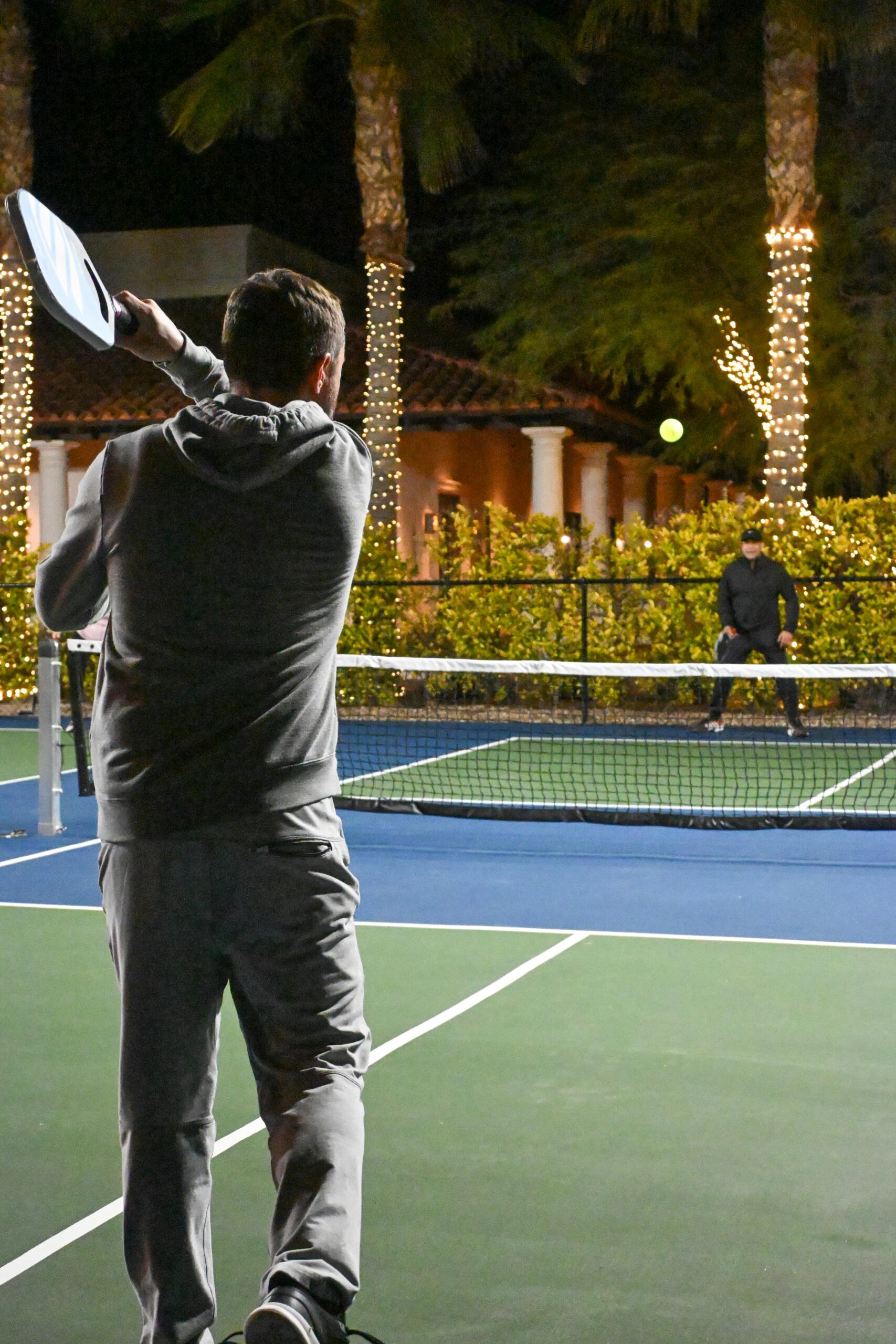
In pickleball, the baseline is for surviving, but the kitchen line is for thriving. If you want to control the outcome of a match, you have to control the Non-Volley Zone (NVZ).
At Athletes Untapped, we constantly see players work incredibly hard to get to the net, only to become passive once they arrive. They stand flat-footed, push the ball around aimlessly, and wait for the opponent to make a mistake.
Elite players do the exact opposite. They use their positioning at the kitchen line to suffocate the opposition, dictate the pace of the dink battles, and pounce on the slightest inaccuracy. Net play dominance is about fast hands, quiet feet, and aggressive patience. Here is how to transform your net game from purely defensive to an unrelenting offensive weapon.
Connect with a Private Pickleball Coach: https://athletesuntapped.com/browse/pickleball/
Why Net Play Dominance Matters
When all four players are stationed at the kitchen line, the distance between paddles is merely 14 feet. At this proximity, the team with the most disciplined net play holds all the cards.
Taking Time Away: By standing toe-to-toe at the NVZ line, you cut off the flight path of the ball early. This robs your opponents of the time they need to set their feet and react, turning a standard volley into a high-pressure situation.
Creating Impossible Angles: You cannot hit sharp, wide angles from the baseline. Being at the net allows you to dink the ball out wide, pulling your opponents entirely off the court and opening up massive gaps in the middle for a put-away.
Forcing the Pop-Up: Dominant net play isn’t always about hitting the ball as hard as you can. It is about hitting unattackable dinks at the opponent’s feet, forcing them to reach and ultimately pop the ball up into your strike zone.
Best Drills to Build Fast Hands and Precision
You cannot build dominance at the net by simply playing recreational matches. You need targeted repetitions that stress your reflexes and your discipline. Here are 4 drills AU coaches use with their athletes.
1. The Figure-8 Dink Drill
How to perform it: You and your partner stand straight across from each other at the kitchen line. You hit a cross-court dink, your partner hits a straight-ahead (down the line) dink, you hit a cross-court dink, and they hit straight ahead. The ball travels in a continuous Figure-8 pattern.
Why it works: It forces you to constantly change the direction of the ball while maintaining a soft touch. It requires active footwork to slide and cover the different angles being created.
Coaching Tip: Do not break your wrist to change direction. Push the ball with your shoulder and keep your paddle face remarkably stable.
2. Rapid-Fire Volley Exchanges
How to perform it: Both players stand right at the NVZ line. Start a cooperative volley rally, keeping the ball in the air. Gradually increase the pace until both players are hitting the ball as hard and as fast as they can directly at each other.
Why it works: It overloads your central nervous system. When you practice catching 50 mph volleys from seven feet away, a normal speed-up in a real game will feel like it is moving in slow motion.
Coaching Tip: Keep your paddle out in front of your chest. If your paddle drops to your waist or goes behind your body, you will be late.
3. The Target Punch Volley
How to perform it: Place two cones deep in the back corners of the opponent’s baseline. Have a partner feed you waist-high balls at the net. Step in and aggressively “punch” the volley, aiming to land the ball exactly on the deep cones.
Why it works: A common mistake is swinging down on a volley, which hits the net. The punch volley teaches you to drive the ball deep through the court, keeping your opponents trapped on the baseline.
Coaching Tip: The motion should be compact, like a boxer throwing a short jab. Stop your paddle abruptly after contact; do not follow through wildly.
4. The “Attack or Reset” Drill
How to perform it: Your partner stands at the kitchen line and feeds you random balls—some high, some low, some fast, some slow. You must instantly decide whether the ball is attackable (above the net) or unattackable (below the net). If it’s high, smash it. If it’s low, softly reset it into the kitchen.
Why it works: Decision-making is the hardest part of net play. This drill trains your brain to recognize the height of the ball instantly and choose the correct shot without hesitation.
Coaching Tip: If you have to guess, reset the ball. Attacking a low ball is the fastest way to lose a point.
Common Mistakes Players Make
The kitchen line is a high-stress environment. When pressure mounts, technique often breaks down. Our coaches constantly work to eliminate these specific errors.
The Windshield Wiper Swing: Taking a massive, sweeping swing at a volley. In pickleball, less is more at the net. Big swings create huge timing errors and expose your body to a counter-attack. Keep your swings incredibly compact.
Backpedaling on Speed-Ups: When an opponent hits the ball hard, the natural human reaction is to step backward. This takes away your balance and forces you to pop the ball up. You must hold the line, lean in, and block the ball with a firm paddle.
Dropping the Paddle: Resting your paddle by your knees between shots. The ball will be past you before you can raise it. Your paddle should always rest at chest-height, in a neutral ready position (the 10 o’clock or 11 o’clock angle).
Attacking Unattackable Balls: Trying to speed up a ball that is bouncing two inches off the ground inside the kitchen. You have to respect a good shot from your opponent. If it is low, dink it back and wait for a better opportunity.
How Private Coaching Accelerates Improvement
Net play is a game of millimeters and milliseconds. A slight tilt of the paddle face changes a winning volley into an unforced error.
This is where private coaching is essential.
A private pickleball coach can:
- Isolate Paddle Angles: We show you exactly how open or closed your paddle face needs to be to counter a heavy topspin drive versus a flat speed-up.
- Feed Under Pressure: We can rapid-fire feed you balls at your weak hip or your dominant shoulder, forcing you to develop the muscle memory to defend the hardest spots on your body.
- Correct Footwork Instantly: If you are crossing your feet instead of shuffling along the kitchen line, we intervene and correct your movement patterns before they become ingrained habits.
- Teach the Offensive Lob: We help you add advanced layers to your net game, recognizing when opponents are leaning too far forward so you can perfectly execute a lob over their heads.
Frequently Asked Questions About Pickleball Net Play Strategy
Where should my eyes be during a dink battle?
Watch your opponent’s paddle, not their face. The angle of their paddle face right before contact will tell you exactly where the ball is going, giving you a split-second head start.
How do I defend a ball hit directly at my chest?
Use the “chicken wing” block. Tuck your dominant elbow tight to your ribs, keep your paddle face completely vertical, and use your backhand to absorb the pace. Do not try to hit a forehand if the ball is jammed into your body.
When is the right time to attack a dink?
Patience is key. You should only attack a dink if the ball bounces high enough that you can strike it while it is above the white tape of the net. This is known as “hitting down” on the ball.
What is an Erne?
An Erne is an advanced offensive play where you quickly step or jump outside the sideline (bypassing the kitchen entirely) to smash a ball out of the air right next to the net post. It requires elite timing and surprises the opponent.
Find a Private Pickleball Coach: https://athletesuntapped.com/browse/pickleball/
Conclusion
Dominating the net in pickleball requires a delicate balance of aggressive intent and defensive patience. It is about holding your ground, keeping your hands fast, and waiting for the perfect moment to strike.
By keeping your paddle up, shortening your swings, and respecting the unattackable ball, you will turn the kitchen line into a fortress that your opponents dread challenging.
About Athletes Untapped
Athletes Untapped connects pickleball players with experienced private coaches who specialize in net play, hand speed, and high-level strategy. Through personalized instruction and structured training plans, Athletes Untapped helps players eliminate unforced errors and command the kitchen line.
Find an experienced coach near you: https://athletesuntapped.com
Learn from our very best Coach!