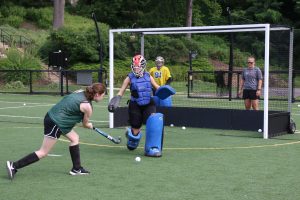

In field hockey, raw athleticism will only get you so far. You can be the most conditioned runner on the pitch, but if the ball constantly bounces off your stick or you struggle to change direction in tight spaces, your speed is completely neutralized. Field hockey is a sport of microscopic adjustments, precise wrist rotations, and sudden angular cuts. The player who dominates the midfield is the one who has painstakingly programmed their hands and feet to work in perfect synchronization.
At Athletes Untapped, our coaches notice that many players complicate their individual training. They try to set up massive, confusing obstacle courses or rely entirely on team scrimmages to get their touches. This lack of focused, isolated repetition leads to sloppy stickwork, wide turning arcs, and a highly frustrating tendency to lose the ball the moment a defender steps into their personal space.
The secret to building lightning-fast hands and unshakeable ball control doesn’t require expensive equipment or a full team; it lies in mastering simple, highly effective cone drills for field hockey. Proper execution of cone patterns fixes these loose, chaotic habits. It allows players to utilize sharp V-drags, master their left-to-right pulls, and establish a deeply ingrained technical foundation that translates directly to game-day elusiveness.
Connect with a Private Field Hockey Coach: https://athletesuntapped.com/browse/field-hockey/
Why Cone Drills for Field Hockey Matter for Athlete Development
In field hockey, just like in business operations or marketing, maximizing your return on investment is everything. When you are juggling a packed schedule of high-level academics, preparing for upcoming university transitions, and applying for competitive leadership roles, your free time on the turf is incredibly limited. You simply cannot afford to waste an hour wandering aimlessly with a ball. Cone drills provide the ultimate structural efficiency.
- Game Performance: Elite cone training directly translates to winning 1v1 isolation battles. When you fully understand how to execute a tight, rapid weave through a line of cones, you are training the exact lateral quickness needed to bypass a defender’s flat-stick tackle. You turn a crowded, chaotic defensive block into a clean offensive breakaway simply because you have the close-control necessary to navigate the traffic.
- Confidence: Our coaches have seen athletes improve faster when they master their fundamental mechanics in a structured environment. When you know exactly how the ball reacts to the roll of your wrists around a cone, the fear of turning the ball over under pressure instantly vanishes. You gain the composure to keep your eyes up, trusting your hands because your muscle memory is backed by rigorous, highly concentrated repetition.
- Long-Term Development: As you progress to higher levels of play, the game becomes incredibly fast and confined. You no longer have the luxury of taking long, slow touches to change direction. A tactically sound foundation built through cone drills protects you from being easily dispossessed. It provides the elite hand-eye coordination needed to manipulate the ball in a phone booth, ensuring your value scales as a highly technical playmaker.
Best Drills / Tips / Techniques
You cannot master your stickwork by just casually jogging around a cone and tapping the ball. You need active, intense, and highly structured patterns that force you to drop your hips, rotate your wrists, and use your peripheral vision. Here are 5 of the absolute best cone drills AU coaches use to build elite field hockey players.
1. The Tight-Space Figure Eight
Place two cones roughly two feet apart. Get into a deep, lunging athletic stance and slowly weave the ball through and around the cones in a continuous figure-eight pattern. The ball must never leave the face of your stick.
This is the absolute foundation of close-quarter ball control because it forces you to use both the forehand and reverse sides of your stick in equal measure. It teaches the athlete the complex mechanics of cupping the ball to prevent it from slipping away.
Focus entirely on rolling your top left wrist while keeping your bottom right hand incredibly loose. A frequent error here is squeezing the bottom hand too tight, which locks the shoulders and forces a rigid, sweeping arm motion rather than the quick, fluid snap of the wrists.
2. The Zig-Zag V-Drag Matrix
Set up five or six cones in a staggered zig-zag pattern, each about five yards apart. Dribble aggressively toward the outside of the first cone, come to a sudden stop, execute a sharp V-drag pull-back to change your angle, and explode toward the next cone in the sequence.
Beating a defender is rarely about running in a straight line; it is about deception and changing gears. This drill builds the critical deceleration mechanics and wrist dexterity required to completely freeze a defender before attacking their weak side.
Pull the ball sharply backward with the toe of your stick and step aggressively into the new open space. Athletes frequently make the mistake of dragging the ball in a wide, lazy “U” shape around the front of the cone, which completely loses the element of surprise and exposes the ball.
3. The 360-Degree Box Control
Create a small 5×5 yard square with four cones. Start in the center. Dribble out to the first cone, circle it completely 360 degrees while keeping the ball strictly on your forehand, return to the center, and repeat the sequence for the remaining three cones.
Field hockey requires moving at sharp angles and shielding the ball with your body. This drill heavily reinforces basic turning mechanics, footwork, and physical ball protection. It teaches the player how to use their body as a barrier between the cone (the defender) and the ball.
Take short, choppy, rapid steps as you circle the cone to maintain absolute control of your turning radius. A massive trap is attempting to take long, sweeping strides while turning, which completely destroys your balance and pushes the ball too far away.
4. The Offset Slalom (Indian Dribble)
Line up eight to ten cones in a straight line, placing them about two feet apart. Dribble the ball in a tight weaving pattern through the cones, aggressively pulling the ball from your forehand to your reverse stick with every single step.
The Indian dribble is the most important evasive skill in the sport. Practicing it through a tight slalom builds the rapid left-to-right dragging motion required to weave through a crowded midfield. It forces the player to continuously turn the toe of the stick over.
Keep the ball exactly one stick-length away from your feet at all times. Many players accidentally let the ball get tangled up inside their own cleats during this drill, which makes it physically impossible to execute the next drag or pass.
5. The Chaos Reaction Grid
Randomly scatter ten to fifteen cones inside a 15×15 yard grid. Dribble continuously through the “minefield” for sixty seconds at game speed, reacting instantly to the cones in your path. You must constantly change direction, utilize pull-backs, and execute 3D pops over the cones without ever touching them.
Game situations are entirely unpredictable, and this drill forces the brain to process spatial awareness and execute rapid decision-making. It teaches the player that their hands must operate completely independently from their eyes to process the game effectively.
Scan the horizon constantly and rely on your peripheral vision to track the ball at the bottom of your sightline. A common instinct is to drop the chin and stare straight down at the turf, entirely defeating the purpose of building “heads-up” hockey IQ.
Find a Private Field Hockey Coach: https://athletesuntapped.com/browse/field-hockey/
Common Mistakes Athletes Make
Even when running simple cone drills, technical errors are incredibly common because players focus entirely on moving fast rather than moving correctly.
- The Death Grip: Squeezing the bottom of the stick with maximum pressure happens because players believe a tighter grip equals more control. To correct this, you must loosen your right hand until the stick can slide freely. Ninety percent of the rotational control and finesse must come from the top hand.
- Playing Upright: Standing completely tall with straight legs while weaving through cones completely destroys your center of gravity and slows down your reaction time. Fix this by burning your quads. You must stay in a deep, athletic lunge while dribbling, which gives you the leverage to change directions violently.
- Rounding the Corners: Coasting in wide arcs around a cone instead of making sharp, distinct cuts occurs when players carry too much speed into a turn. You must actively break your speed down with short strides before hitting the cone so you can explode out of the angle cleanly.
- Staring Down at the Turf: Running through a cone matrix with your chin buried in your chest happens when a player lacks the tactile feel to know where the ball is on their stick. Trust the vibration of the stick in your hands and look up; if you stare at the cones, you will never see the open pass in a real game.
How Private Coaching Accelerates Improvement
Cone drills are a fantastic way to build isolation touches, but practicing a flawed grip or a poor posture 1,000 times will only permanently ingrain bad habits into your muscle memory. Trying to self-diagnose your wrist roll, your hand positioning, or your V-drag angle without an expert eye is practically impossible for most players.
This is where private coaching comes in. We have found that personalized instruction helps athletes take the raw effort they put into their cone drills and apply the specific cognitive and physical corrections required to master them, leading to significantly faster skill development.
A private field hockey coach acts as your technical architect. They help accelerate development by breaking down your fundamental mechanics in a controlled setting, providing personalized feedback on how to properly drop your hips and loosen your bottom hand. By utilizing slow-motion video analysis, coaches can correct mistakes early, showing you exactly where you locked your wrists or stood up too tall before those bad habits limit your speed.
Ultimately, this 1-on-1 environment focuses on massive confidence building. When you possess an elite, coach-verified technical foundation, you stop guessing during your solo workouts, allowing you to step onto the turf knowing your efficient training has built an unshakeable set of skills.
Frequently asked questions about Cone Drills for Field Hockey
How often should I do cone drills?
To see massive improvements in your close control, you should dedicate 10 to 15 minutes to highly focused cone drills every single day. Consistent, daily repetition builds the complex neuromuscular pathways required to make rolling your wrists an automatic, subconscious reflex.
Can I do these drills at home?
Absolutely. You do not need a full turf field to build elite hands. You can practice dragging the ball around cones (or shoes, or water bottles) on a smooth garage floor, a driveway, or even short carpet. Using a heavier training ball at home can dramatically improve your wrist strength.
What size cones are best for field hockey?
Low-profile, flat disc cones are the absolute best for field hockey stickwork. They are tall enough to force you to maneuver the ball around them, but flat enough that they will not interfere heavily with your stick swing or cause you to trip if you accidentally step on them.
Should I look at the cones or the ball?
Neither! You should be looking up and forward, using your peripheral vision to track both the ball and the cones. If you stare directly down at your stick, you are building a terrible habit that will result in you running blindly into defenders during a live match.
Do private coaches use cone drills?
Yes. Elite private field hockey coaches rely heavily on cone matrices to build a player’s fundamental baseline. They use cones not just as obstacles, but as visual markers to teach precise spatial awareness, passing angles, and strict defensive positioning.
Conclusion
Mastering essential cone drills for field hockey is the undeniable foundation of a creative, highly elusive, and efficient player. Without a structured focus on isolated stickwork, you are just an athlete chasing the play, leaving your offensive success entirely to luck and allowing the opposing defense to easily strip the ball away.
Improvement is highly achievable with proper, focused mechanical training. Encourage yourself to practice your figure-eights, maintain a loose bottom hand, and embrace the discipline of keeping your head up while you weave. Consistent practice will inevitably yield a much more dangerous, smooth, and unshakable presence on the pitch.
Train With a Private Field Hockey Coach
Athletes Untapped connects athletes with vetted private coaches across the country for one-on-one training.
Private coaching helps athletes:
- improve faster
- build confidence
- receive personalized feedback
- reach their full potential
About Athletes Untapped
Athletes Untapped connects field hockey players with experienced private coaches who specialize in stickhandling mechanics, close-quarter ball control, and building highly efficient, high-ROI practice plans. Through personalized instruction and customized cone drill progressions, AU coaches help attackers and midfielders eliminate stiff hands, master their technique, and completely dictate the tempo of the game.
Find an experienced coach near you: https://athletesuntapped.com
Learn from our very best AU coaches!